
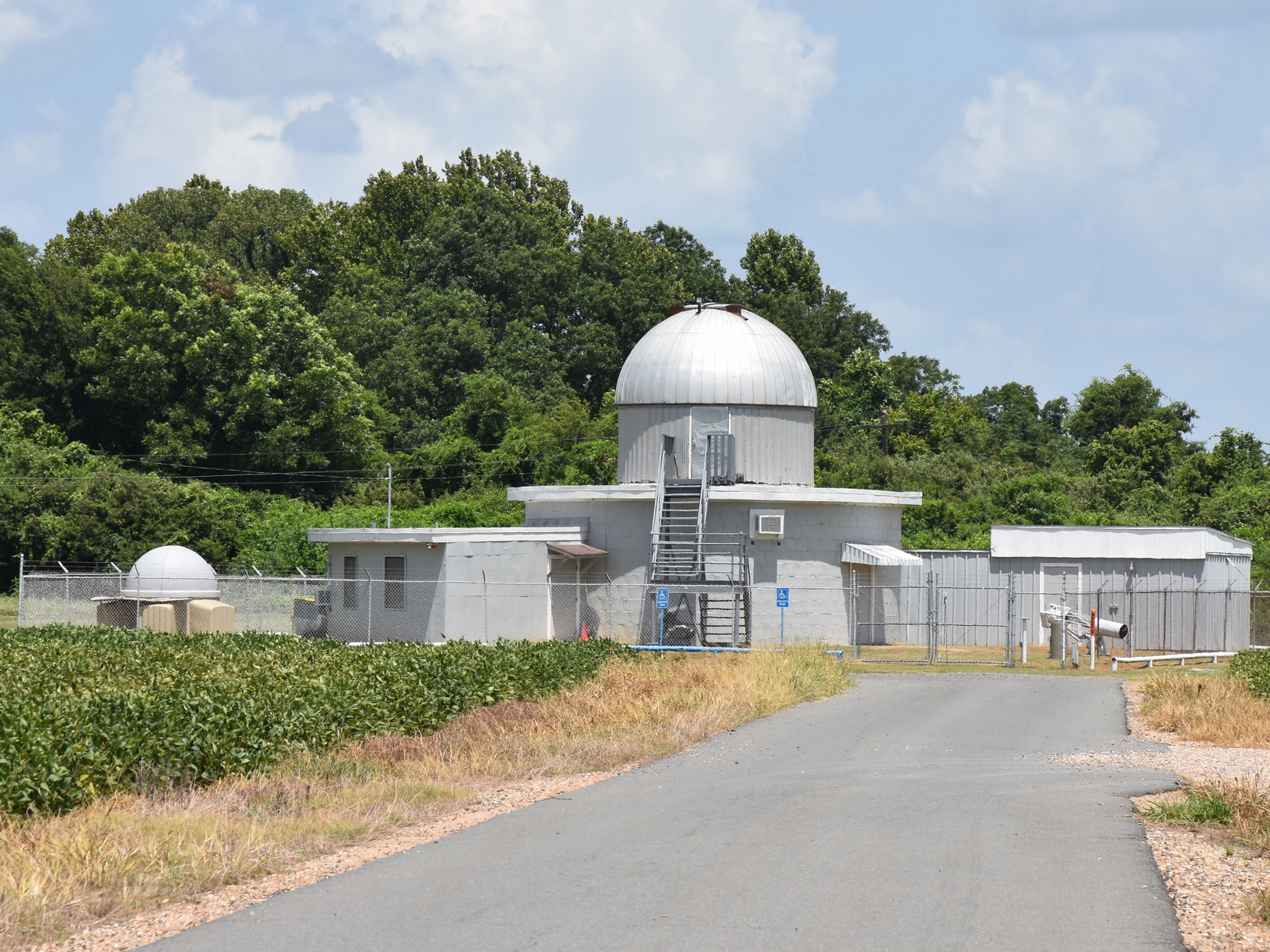
SHREVEPORT – Turn an eye toward the sky Saturday at an observation session at the Shreveport Observatory.
Astronomy enthusiasts will guide the public in viewing numerous objects in the night sky at this free event, which runs from 8-10 p.m at the Worley Observatory in southern Caddo Parish.
Telescopes will be trained on the moon, Venus, Jupiter and its four large moons, as well as various galaxies, star clusters, double stars, and nebula.
“Hosting free public star parties is part of our charter at The Shreveport-Bossier Astronomical Society,” said Dr. Cran Lucas, organization president and science professor at LSUS. “One can expect to observe the moon, planets, and what we call deep sky objects.
“The first time a child or adult sees the rings of Saturn or the cloud bands and moons of Jupiter through a telescope is always a great event. Observing the craters of our own moon up close is also impressive.”
The observatory includes a 14-inch telescope in its dome in addition to personal telescopes that organization members set up.
Visible objects in a spring night sky differ from other seasons. For example, Earthlings in the U.S. can see Saturn and its moon Titan in the fall instead of Jupiter and Venus, which is visible in the spring.
Visible constellations vary season to season.
Worley Observatory is located at 1 Astronomical Observatory off of Gail Red Bluff Road, which is about eight miles south of LSU Shreveport on Hwy 1.
If the sky is clouded out or raining, the star party will be cancelled.
The Shreveport-Bossier Astronomical Society, Inc. is hosting a raffle for a Seestar S-30 Digital Smart Telescope. Tickets are $10 each and can be purchased at the star party or at the organization’s website shreveportastronomy.com.
The observation session is the first since NASA’s Artemis II mission in April which propelled astronauts the greatest distance traveled in space and provided views of the lunar surface never seen before.
“As a space geek since the launch of Sputnik in 1957 and the U.S. Apollo program, I and many other members of the astronomy club are excited about the U.S. getting back to the Moon and beyond,” Lucas said. “The Artemis II mission was above all an engineering test of the capsule and service module with a functional environmental system.
“But it reminds me of the Apollo 8 trip to the moon all those years ago. As with the Apollo program, Artemis missions will contribute to human exploration of space, a better understanding of the challenges of deep space travel on the human body, the generation of new technologies, and the opportunity for numerous scientific experiments.”