
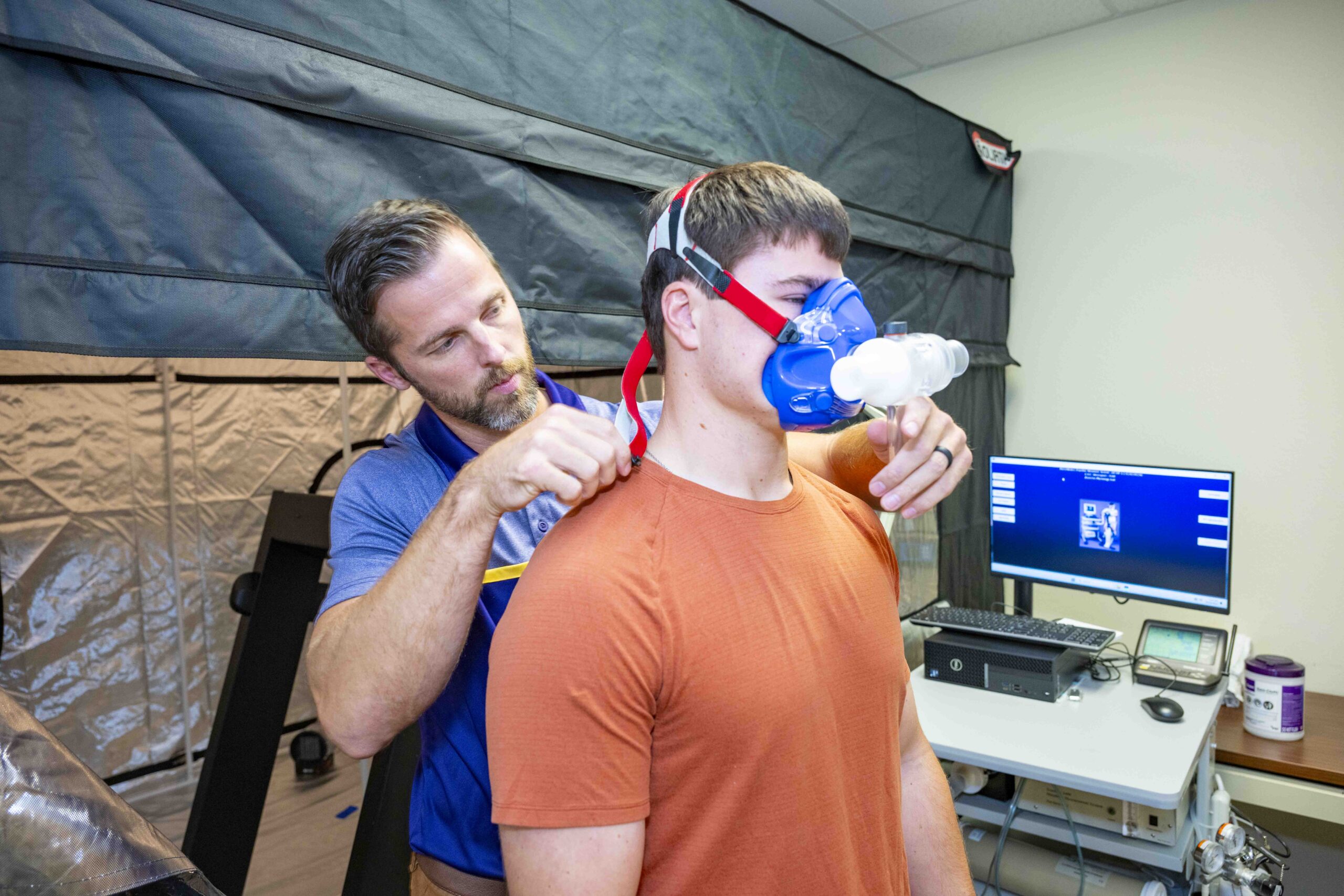
SHREVEPORT, La. — A researcher at LSU Health Shreveport has received a $210,022 grant to study methods for predicting and preventing heat-related illness among high school football players, a leading cause of preventable death in student athletes.
Cory Coehoorn, Ph.D., associate professor of rehabilitation science and family medicine, will lead the project funded through the Collaboration in Action Program, an initiative of the Louisiana State University System in partnership with Our Lady of the Lake Health. The program supports research in areas including sports medicine, trauma, neuroscience and chronic disease.
The study will collect physiological and environmental data from about 100 high school football players in Shreveport, Monroe, Baton Rouge and Houma. Participants will wear upper-arm sensors to track physiological metrics, while researchers monitor environmental conditions such as heat and humidity.
Researchers plan to use the data to refine a machine-learning model designed to predict when an athlete is approaching dangerous levels of heat strain, allowing for earlier intervention.
“We’re essentially trying to prevent heat illness,” Coehoorn said. “In Louisiana, high school athletes experience higher rates of morbidity and mortality because of environmental exposure and the equipment they wear. Our goal is to create a proactive approach rather than a reactive one.”
Heat illness remains a significant public health concern, particularly in states with high temperatures and humidity. Current practices often rely on identifying symptoms after they appear.
“Current practices are largely reactive,” Coehoorn said. “When someone shows signs of heat exhaustion or heat stroke, that’s when interventions begin. By monitoring athletes in real time, we can prevent them from ever reaching that dangerous point.”
The project builds on Coehoorn’s previous research involving heat stress in firefighters, military personnel and other high-risk populations. The team will integrate existing datasets with new data collected from athletes to improve predictive accuracy and develop a tool suitable for real-world athletic environments.
“We’re taking a large dataset we’ve developed over years of research and training a model to make accurate predictions,” he said. “By adding data from football players, we can make those predictions more robust and applicable in real-world conditions.”
A key focus of the project is accessibility for schools with limited resources.
“Many schools don’t have access to equipment like cold immersion tubs,” Coehoorn said. “We want to develop a cost-effective wearable system that can provide real-time heat-risk alerts to coaches and trainers.”
The research team includes Dr. Peter Seidenberg, professor and chair of family medicine; Dr. Miguel Lopez, assistant professor of clinical family medicine at LSU Health Shreveport; and Dr. Travis Currie, a sports medicine physician with Our Lady of the Lake Health. The physicians will help connect the study with high school athletic programs across Louisiana.
Coehoorn said the system could eventually be used beyond athletics.
“I’m hoping to have this system deployed not only for high school football players, but also for firefighters, military personnel and agricultural workers,” he said. “These are groups with high exposure to heat stress, and I believe many of these incidents can be prevented.”