
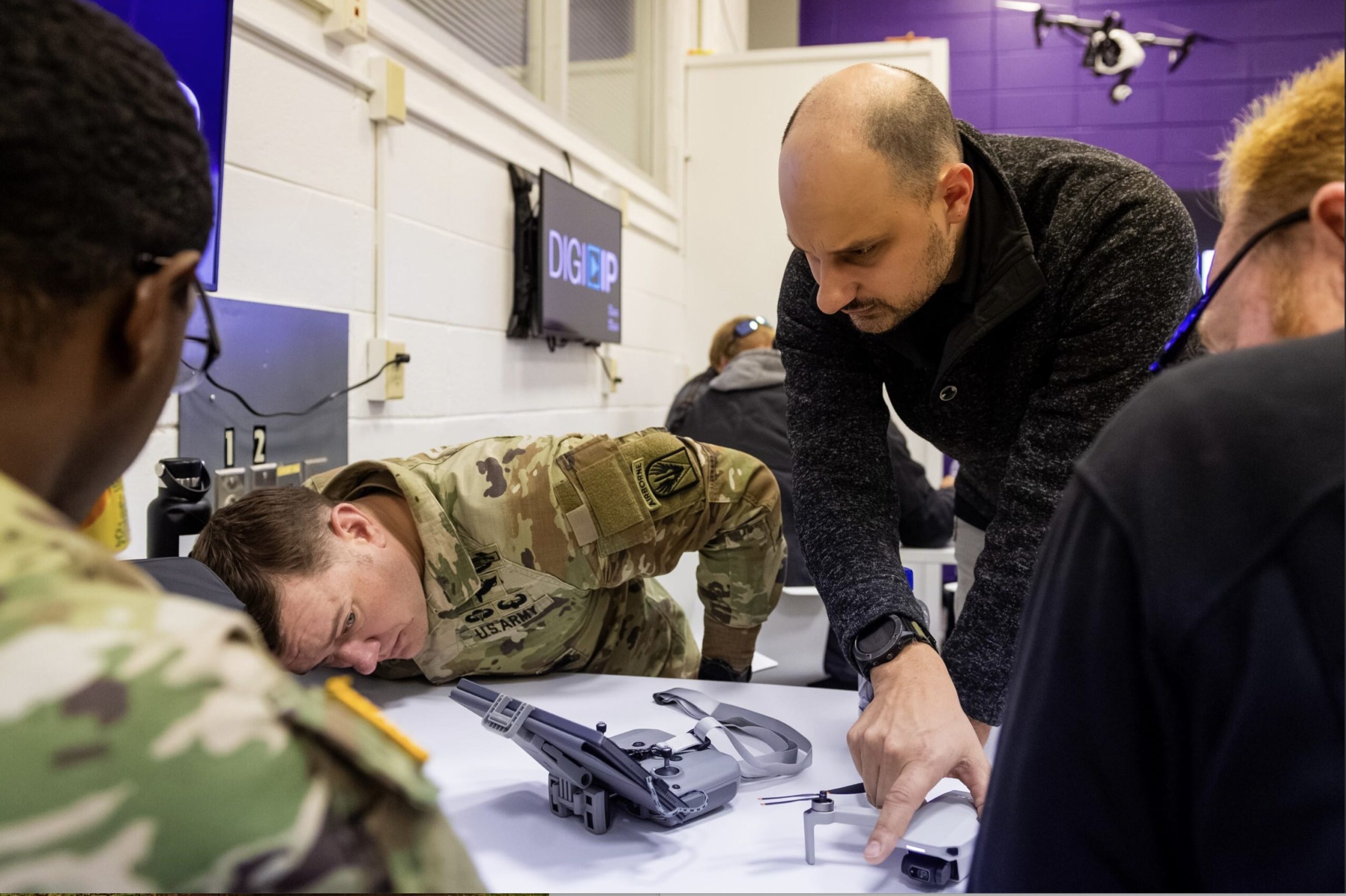
NATCHITOCHES, La. — Northwestern State University’s Advanced Remote and Geospatial Operations Lab is expanding its role in workforce and military training through a recent program aimed at improving unmanned aircraft systems skills among Fort Polk soldiers.
The ARGO Lab at Northwestern State University hosted the training in partnership with the university’s Office of Economic Development and Advancement, providing participants with foundational and operational instruction on drone technology.
“We’re taking participants from the basics of drones, particularly multirotor quadcopters, up through operations, maintenance and applications where you get a full view of what actual utilization looks like,” said JD Cox, director of the ARGO Lab.
The training aligns with broader military initiatives to expand drone proficiency across service members. Cox described the effort as part of a “wave of the present,” reflecting growing demand for unmanned systems expertise.
Soldiers from Fort Polk, including members of the 3rd Brigade, 10th Mountain Division, participated in the sessions. While some attendees had prior experience with drone surveillance, most sought deeper operational knowledge.
“We’re learning more about the drone capabilities, what they’re able to do and how we can implement these in real life scenarios,” said SPC Kevin Ruiz. “We are improving more of our skills implementing these technologies.”
Training covered drone classifications, multirotor systems, sensors, battery management and flight operations. Additional instruction included aviation weather, aeronautical decision-making, crew roles, mission planning and execution, and advanced sensor use. Participants also practiced assembling and disassembling larger drone systems.
Mark Leslie, director of Plans, Training, Mobilization and Security at Fort Polk, said the program demonstrated strong overlap between civilian and military drone applications.
“Overall great first program,” Leslie said. “The parallels of what the civilian drone world does and what the military’s UAS world executes were quite amazing.”
The ARGO Lab has developed a regional presence in drone education, offering courses for law enforcement, industry professionals and civilians pursuing Federal Aviation Administration Part 107 Remote Pilot Certification. Leslie noted that certification-focused training could provide additional value for soldiers in future sessions.
“I think one of the most valuable periods of instruction was mission planning,” Leslie said, adding that future training could include more tailored exercises based on specific platform capabilities.
The university recently hosted a two-day training at its Alexandria campus and plans another session April 25-26 at its Leesville/Fort Polk campus. The course costs $250 per session, with the FAA Remote Pilot Certification exam administered separately at approved testing centers.
Cox said the collaboration reflects an ongoing partnership between the university and the military installation, with potential for expanded training opportunities.
“Any amount of information we can put out there on how to use drones in the modern world, I think it’s beneficial,” he said.