
By Nolan Mckendry | The Center Square
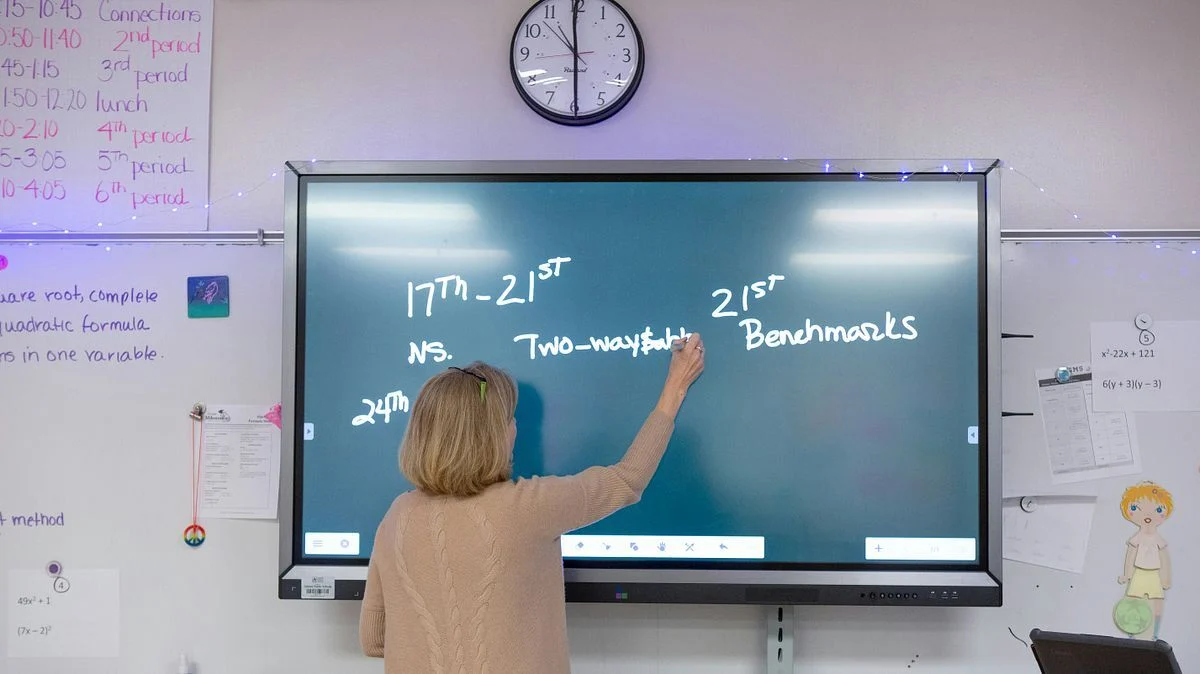
A teacher speaks to students during a classroom lesson with educational materials on the desk. Photo: Yan Krukau / Pexels.
(The Center Square) – Louisiana education officials have issued long-awaited instructions explaining how school systems must handle Gov. Jeff Landry’s decision to redirect $168 million in public school funding toward teacher and support staff compensation.
The Board of Elementary and Secondary Education convened a special meeting that lasted about 10 minutes to review the guidance, which the Louisiana Department of Education planned to send to school systems immediately afterward.
Landry’s executive order reduced funding distributed through the Minimum Foundation Program, the formula Louisiana uses to finance public schools, by $168 million.
The money will instead flow through the Department of Education with the requirement that teachers receive at least $2,000 and support employees receive at least $1,000 in additional compensation during the 2026-27 school year.
The additional compensation may be provided as a one-time stipend or a permanent pay raise. The $168 million total also includes the employer retirement contributions associated with the payments and is based on each school system’s staffing levels reported in fall 2025.
State Superintendent of Education Cade Brumley called the funding maneuver “truly unprecedented” and said school systems needed the guidance to finish or revise their budgets.
“We’re certainly excited about the opportunity for teachers to see a stipend again,” Brumley said. “Personally, I’m hopeful that through some of the work that’s taking place, teachers can see increased pay, not just in the form of a stipend, but in a permanent way moving forward.”
The rules divide school systems into three categories based on what their local boards have already approved.
School systems that have already adopted raises or stipends of at least $2,000 for teachers and $1,000 for support staff will be considered compliant. Those districts will not have to provide another raise and may place the redirected state allocation into their general funds for other expenses.
Districts that approved smaller increases must use enough of the state money to make up the difference. For example, a district that already approved a $1,500 teacher raise would have to provide at least another $500. Any money remaining after employees receive the required amount may be used for other general fund expenses.
School systems that approved no raise or stipend must distribute the money as $2,000 teacher stipends and $1,000 support staff stipends.
Districts have until May 1 to make the required payments. They must also provide the Department of Education with school board minutes showing approval of the budget and salary schedule containing the increases.
Ordinary salary schedule increases received because an employee completed another year of service or earned additional education will not count toward the required amount. However, a districtwide increase in the value of the salary schedule will count.
For example, if a teacher moved to a salary step that paid $1,000 more because of another year of experience, that increase would not qualify. If the district separately increased the salary attached to that step by $500, the additional $500 would count toward the state requirement.
The guidance also directs school systems to concentrate any budget reductions needed to accommodate the compensation requirements on non-instructional spending. Security, student transportation and food services must remain intact.
Brumley acknowledged that local officials are being forced to reconsider spending decisions after the state changed the way the money will be distributed.
“They’re having to make difficult decisions on the best way to serve the students under their care, given the shift in funding that they are receiving,” Brumley said.
He asked communities to “show grace” to local school systems as they revise their budgets around the state’s new priorities.
The allocation covers classroom teachers and several categories of support employees, including aides, clerical workers, service workers and skilled craftsmen. The calculation does not include principals, assistant principals, counselors, school nurses, central office administrators, prekindergarten employees or resident teachers.
Brumley said the department developed the instructions with the governor’s office, Board of Elementary and Secondary Education leaders and the board’s legal counsel.
“Our intent with this particular guidance is, at the conclusion of this meeting, we would go ahead and submit this information to the school systems across the state,” he said. “We know that they want that and they need that.”