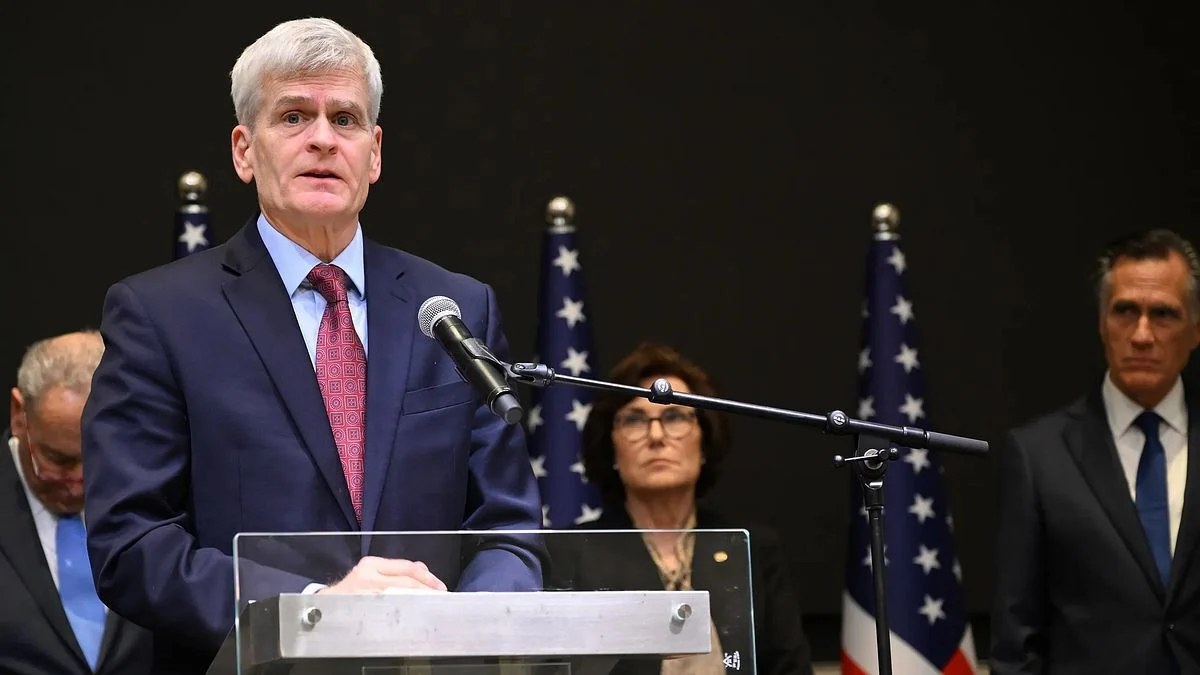
(The Center Square) – U.S. Sen. Bill Cassidy is running for a third term on a pivotal wager: that a record of delivering federal dollars to Louisiana and pushing bills into law matters more to Republican primary voters than the approval of President Trump.
His willingness to buck Trump might prove too risky for re-election in a state that has overwhelmingly supported the president over the past decade. Trump’s endorsement in the race went to U.S. Rep. Julia Letlow, who announced her candidacy this month after he publicly urged her to run. Five other Republicans had already lined up to challenge Cassidy: state Treasurer and former U.S. Rep. John Fleming, state Sen. Blake Miguez, Public Service Commissioner Eric Skrmetta and St. Tammany Council member Kathy Seiden. State Rep. Julie Emerson ended her bid this month.
Each shares what they consider a crucial advantage over Cassidy: no history of breaking with Trump.
Cassidy’s vote to convict Trump following his impeachment over the Jan. 6, 2021 Capitol riots is a centerpiece of his rivals’ attacks. Miguez branded him a RINO – “Republican In Name Only” – saying “loyalty matters” and “we sure don’t forget.” Fleming posted on X that he has “never violated a promise, opposed President Trump or betrayed the people of Louisiana whom I serve.”
Cassidy appears undeterred. “This race will not be determined by endorsements,” Cassidy told The Center Square. “This race will be determined by who delivers for Louisiana.”
To that end, he has been criss-crossing the state, appearing at a Right to Life March on Saturday in Baton Rouge, an anti-abortion rally that draws tens of thousands of supporters, and reminding voters of his endorsement from anti-abortion groups.
He has noted at least $14 billion for Louisiana roads, bridges and high-speed internet, and $208 million that aims to improve health care in rural communities. While visiting a St. James Parish aluminum production facility, he pointed to grants and loans “so that they can not just stay in business, but expand.”
Cassidy “has the ability to legitimately take credit for a lot of the funding that’s flowed to the state in recent years due to the infrastructure bill,” Robert Hogan, a Louisiana State University political science professor, told The Center Square. “Given all that, you would think, why in the world would he be in what some people are saying is pretty much a pickle here?”
Were it not for his impeachment vote, Hogan said, his seat might be safer.
The tightrope Cassidy has been trying to walk to re-election is featured in his first television ad, where he stands next to Trump as he signs a bill meant to impose harsher penalties on fentanyl traffickers. Cassidy, who backed the bill, notes that Trump called it one of the more important ones to become law.
Nearly a year ago, Cassidy, a physician who supports government efforts to encourage public vaccinations, voted to confirm Robert F. Kennedy Jr., a vaccine skeptic, as Trump’s health care secretary.
But after the fatal shooting this month of Minneapolis nurse Alex Pretti by several ICE agents, Cassidy called for an investigation, saying “the credibility of ICE and DHS is at stake.” Days later, he said “Second Amendment rights don’t disappear when you exercise other rights,” a clear reference to the Trump administration noting that Pretti, a licensed firearm carrier, had a gun at the protest.
Brian Brox, a political science professor at Tulane University, said he wonders if Cassidy is “beginning a strategy of independence.”
“Cassidy came out among the more forceful Republicans in the last few days calling for investigations of the ICE events in Minnesota,” Brox told The Center Square. “He’s walked much farther out on that than any other kind of establishment Republican has.”
In another independent streak, Cassidy told The Center Square that Congress bears some responsibility for expanding the power of presidents, including in the Trump administration.
“A lot of the executive orders have been reversing Biden executive orders, which begs the question: Why have presidents since George W. (Bush) been resorting to executive orders?” he said. “Because, in part, Congress has not worked well.”
“If Congress works better, then Congress is stronger and it pushes back,” he said.
Cassidy’s positions could further complicate his bid in Louisiana’s new closed-party primary system. For the first time since 1975, Republicans and Democrats will pick their nominees in separate primaries. Registered Republicans will vote in the GOP primary, while unaffiliated voters can choose which primary to vote in.
This shift raises Cassidy’s stakes with Republican activists who have been Trump’s biggest supporters, Hogan said. The cross-party support Cassidy has relied on in past statewide races can’t bail him out in a GOP-only contest, Hogan said.
“Who is going to turn out to vote is going to be the party activist, and I think they are going to be strongly favoring Trump,” Hogan said. “He was in a difficult spot before this. He’s in an extremely difficult spot now.”
Cassidy has raised enough for an aggressive primary campaign, with over $11 million in his war chest. He said a recent fundraiser netted $650,000.
“The buzz on the street, the buzz from the fundraising, the buzz from meeting people from all walks of life has been fantastic,” he said.
But his challengers stand a solid chance of unseating him, Hogan said, even those who have not been endorsed by Trump.
“Cassidy was in trouble before Letlow,” Hogan said.