
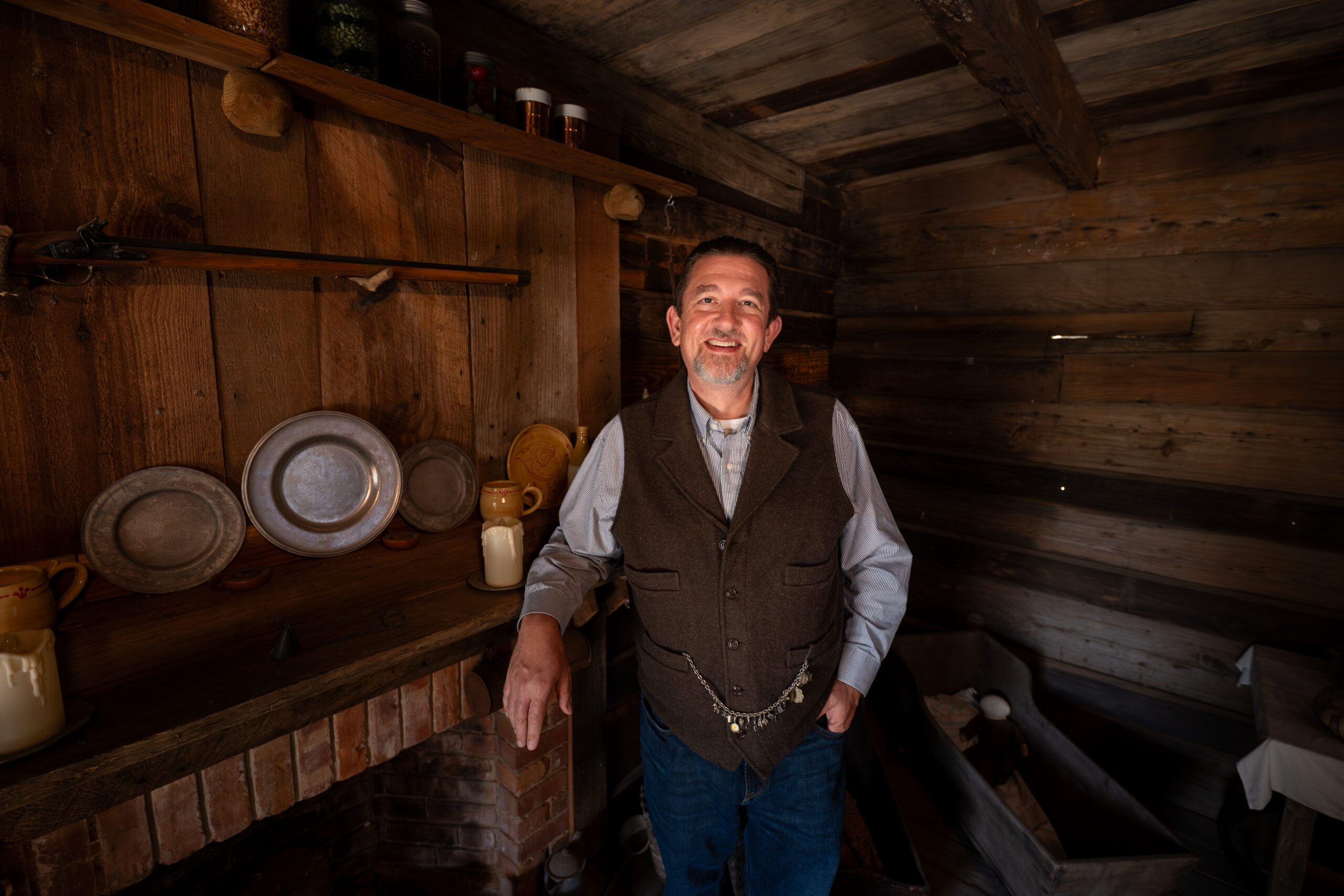
SHREVEPORT – When LSU Shreveport’s Marty Young walks across the grounds of the Pioneer Heritage Center and its seven historic structures, he can see two buildings on the National Register of Historic Places (NRHP).
Throughout his nearly three decades at LSUS, he’s maintained and restored those structures, following stringent guidelines.
That kind of work made Young a fit for Louisiana’s National Register Review Committee, where he started his term with the winter meeting this past December.
“It’s such an honor to be nominated and selected,” said Young, the director of the Pioneer Heritage Center. “It means a lot to be recognized for the work I’ve done through the years on historic buildings.”
Young serves on a committee that evaluates and votes on the eligibility of historic property nominations across the state.
The committee’s recommendations advise the State Historic Preservation Officer on Louisiana’s nominations to the National Register.
The Historic Registry program is managed by the National Park Service.
The state committee, which ranges from nine to 13 members who have expertise in historic preservation, includes three representatives from North Louisiana (including Young).
The committee can also advise local entities on the nomination process and how to maintain the historic integrity of recognized places or places hoping to be nationally recognized.
Young directs the maintenance and restoration of all seven of the Pioneer Heritage Center structures, including two on the national registry (Caspiana House and Thrasher House).
The Caspiana House is an antebellum cottage built in 1856 in what is now southern Caddo Parish.
The Thrasher House is a dogtrot log cabin built in 1850 near Castor in what is now Bienville Parish.
Young has directed restorations of both, including a significant project on the log cabin in 2018.
“Literally the east and west ends of the cabin had to be totally replaced,” Young said. “There are guidelines when you have a building on the national registry, so you can’t just go out and get commercial lumber.
“We found a logging company and mill that could handle this specific type of wood (heart pine, which is rare), and then carpenters got the logs really close to the correct fit and then hand-shaped the logs to fit into place. They finished the logs in that way so it matches the rest of the cabin and not look like a skill saw made the cuts.”
Young then added hand-hewn axe marks to match the original logs.
He said he appreciates the move toward more acceptance of modern techniques by the historic community to better preserve more historic buildings.
“Let’s say you have a historic town structure where you have outward façades and the brick work of homes and businesses, and it’s on the national registry,” Young said. “But now the building needs reframing – are you going out and finding 200-year-old cypress to frame it the way it used to be?
“Or can we use a metal frame on the inside, a frame that isn’t visible once you rebuild the walls and plaster it? I think that’s a good compromise because the structure will last from now until doomsday. I call those hidden compromises.”
Young used more modern wood to replace some of Caspiana House’s rotten 2x4s and 4x4s because 150-year-old wood isn’t readily available and is incredibly expensive.
When Caspiana House needed a new roof, the traditional wood shingles weren’t an option because of the fire hazard created by the new electric and air conditioning systems. The house has a roof with asphalt shingles.
“For example the log cabin – there is a wood framers guild in North Carolina that could come down and do the hand-hewn logs,” Young explained. “But even they would use modern techniques like sawing the logs into within an inch of the dimensions, and then hand-hew the logs from there.
“Now a $75,000 project has turned into a $700,000 project, and is there really any visible difference? You have to have access to original materials and the people with those particular skills to do it that way.”
Authorized by the National Historic Preservation Act of 1966, the NRHP is part of a national program to coordinate and support public and private efforts to identify, evaluate and protect America’s historic and archaeological resources.
More than 100,000 properties across the nation are in the National Register with almost every county/parish in the country having at least one place listed.
A National Register listing is the first step toward eligibility for National Park Service-administered federal preservation tax credits.