
By Darren Svan | The Center Square
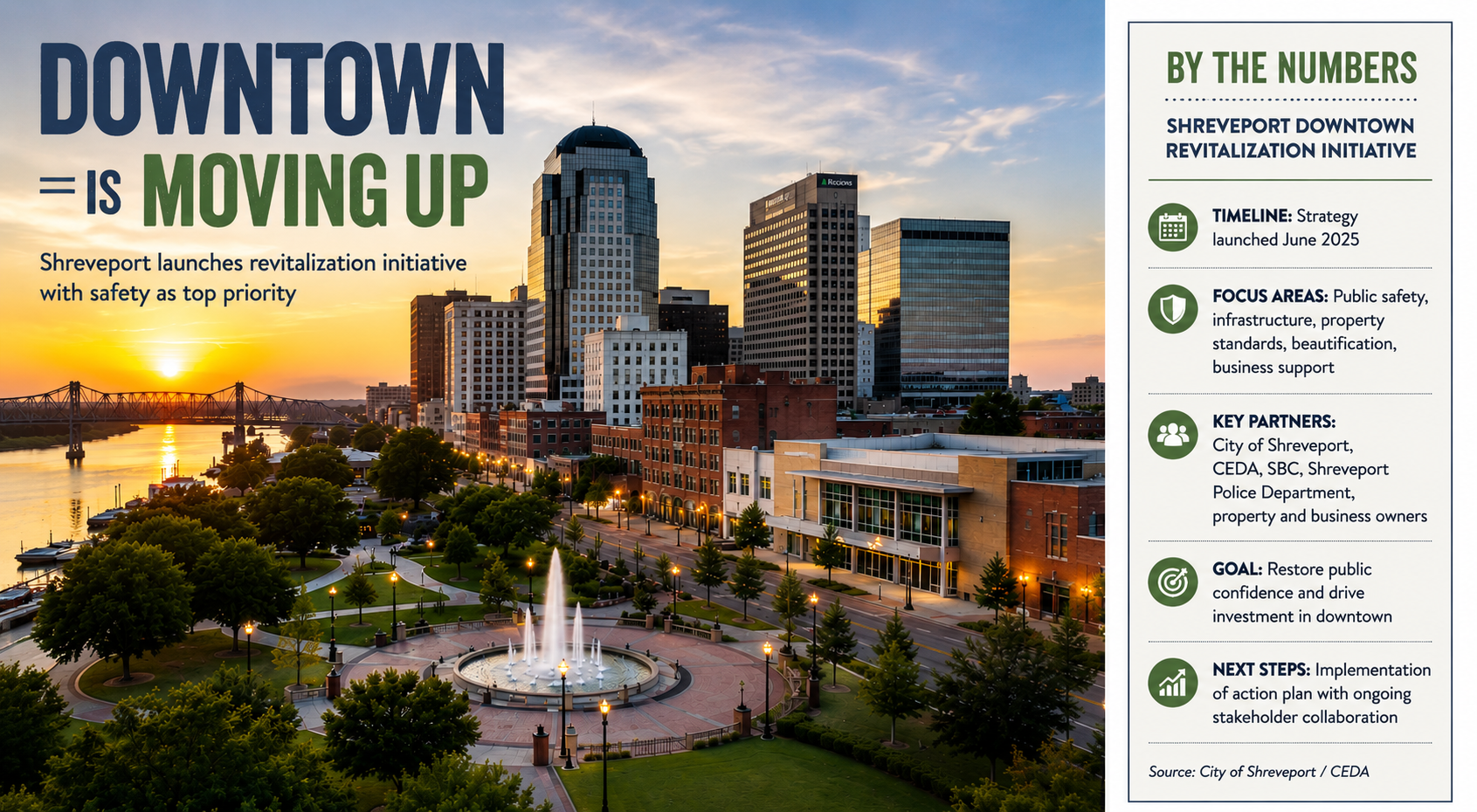
Business leaders and those working and living in the district share a repeated observation – plans to revitalize downtown are unlikely to succeed without changing a widely-held perception that it’s unsafe.
Poor lighting, excessive garbage, vacant buildings, and poorly maintained buildings were identified as deterrents for prospective investors.
The consultant, Retail Strategies with offices in Texas, Mississippi and Alabama, rolled out a 45-question survey this month, an initial step toward developing a plan to attract businesses.
The contract with Retail Strategies spans three years.
“The big thing is they hold your feet to the fire,” said Bill Sabo, the city’s director of economic development. “They work with you for three solid years.”
Downtown was a place where Shreveport shopped, dined out and found music and entertainment. Changing economic conditions, population decline and movement to the suburbs contributed to disinvestment and increasing commercial office vacancy.
Sabo says it’s time to align with and leverage recent commitments from private investment. Companies have announced multi-million dollar plans to convert vacant buildings to residential apartments, redevelop the film and entertainment industry and reinvest in the gaming industry.
“We want to capitalize on those things,” Sabo said, adding that “the city can’t do everything. If we don’t get people involved, it won’t be successful.”
Improving downtown will require greater buy-in from the broader Shreveport community, according to Sabo.
Attracting major “anchors” like a medical center, university campus or corporate office is an effective model for successful downtowns, he said.
Downtown advocates and business owners interviewed by The Center Square said public safety remains their top concern, arguing other revitalization efforts depend on improving it first.
“We do support the police but we can’t scream come get the homeless when there are shootings elsewhere,” said Pattie Horn, whose family owns a six-story building and popular restaurant, The Missing Link, across the street from the Caddo Parish Courthouse. “We are not a priority.”
Police Chief Wayne Smith said this week that his police department is short 164 officers. The department is currently operating with 417 officers, who regularly take on additional overtime shifts.
“I love our police but they can only do so much,” Horn said.
Panhandlers have grown more belligerent and aggressive through the years, she said, and are willing to approach customers in the building or those who are eating lunch on the patio.
“If you want people to come downtown, you don’t just clean up when a dignitary comes to town, you do it in practice,” she said.
YMCA Branch Director Victor Giglio, whose facility is open on McNeill Street from dawn to dusk, encounters two classifications of individuals – a limited number of homeless people, who are not violent, and then panhandlers and day loiterers.
“If somebody is flopped down with a wagon full of clothes, people will be uneasy about coming down to Rhino Coffee, Noble Savage or the Missing Link,” Giglio said.
If police enforced the law in the downtown district, visitors would feel safer, said Giglio, who shared stories of individuals harassing his staff and defecating and urinating in public.
“We will have a talk with (panhandlers) and ban them but they will keep coming back to our building,” he said.
Shreveport has an anti-panhandling ordinance that makes it unlawful to, among other things, ask, beg or solicit money using spoken, written or printed words; block or interfere with someone’s movement; solicit in a manner that would make a reasonable person fear bodily harm, according to the ordinance.
“When you can’t walk from your car to the business without being approached by three aggressive panhandlers, they won’t come down here,” said Tim Huck, who owns four downtown buildings and operates the Sand Bar on Spring Street. “You don’t need to pay a firm a whole bunch of money to figure that out.”
One of the challenges for law enforcement is that officers must first be made aware that panhandling is occurring, said police spokesperson Chris Bordelon.
“Officers must observe or receive information that an individual is actively soliciting money or other items before determining whether enforcement action may be appropriate,” Bordelon said. “Another challenge is that many individuals who panhandle are experiencing homelessness, mental health crises, substance abuse issues, or other significant hardships.”
In 2026, police arrested or cited 10 individuals for panhandling or soliciting money in Shreveport; none of those arrests were made downtown.
At the time of publication Bordelon said of the 45 incidents reported to police none came from downtown.
Like others, Huck said the city needs to enforce all of its laws, not just criminal laws but property standards, too.
“The blight, they should actually enforce those laws,” Huck said. “They wrote a vacant building rule that they don’t enforce.”
The city has maintenance rules for commercial buildings. Owners must maintain exterior walls, windows and roofs, remove graffiti, secure vacant buildings and only allow plywood to remain for 90 days. The ordinance includes a list of additional items.
Enforcement is handled by the city’s Property Standards department. Terrance Green, director of Property Standards, did not respond to The Center Square’s request for an interview.
“We have so many vacant buildings that are not being maintained or managed at all,” said Shilpan Patel, who owns Noble Savage on Texas Street. “I see people investing money in our buildings to light it up and brighten up the area, then two next to them are boarded and vacant buildings. That’s my biggest concern.”
Patel suggests having the business community and city leaders on the same page working from a consistent plan that’s applied broadly throughout downtown.
None of the people The Center Square interviewed were aware of the city’s survey and revitalization initiative.
“Having more businesses is better for everybody,” Patel said. “People don’t realize that downtown is one of the safest areas but they are afraid.”
Sabo said, “One of the keys is the perception of what goes on downtown. Public safety is the bedrock that everything has to be built on.”
The survey and revitalization project is funded in part by the Downtown Development Authority, and is part of the DDA’s effort to update the Downtown 2010 Redevelopment Strategy, according to a statement issued by the city.
Executive Director Cedric Glover declined to be interviewed. The DDA is working in partnership with the city’s economic development department, who is leading this initiative and handling media engagement for this effort, he said.
Feedback from the survey will help shape priorities related to downtown vibrancy, business growth, tourism, walkability, design and redevelopment, according to the city statement.
That survey can be found here: https://www.surveymonkey.com/r/DowntownShreveportLA.