
Editor’s note: This is the second in a BIZ Magazine series examining economist Loren Scott’s 2027-28 forecast for Northwest Louisiana, the projects driving the outlook and the challenges that could shape whether the region realizes that growth.
SHREVEPORT-BOSSIER, La. — Amazon’s $18 billion data center investment may be the headline project in Northwest Louisiana, but economist Loren Scott says the region’s growth story extends well beyond data centers.
From renewed activity in the Haynesville Shale and expansions at the Port of Caddo-Bossier to growth at the National Cyber Research Park and new technology tied to the region’s medical sector, Scott sees multiple pieces coming together to drive the Shreveport-Bossier economy over the next two years.
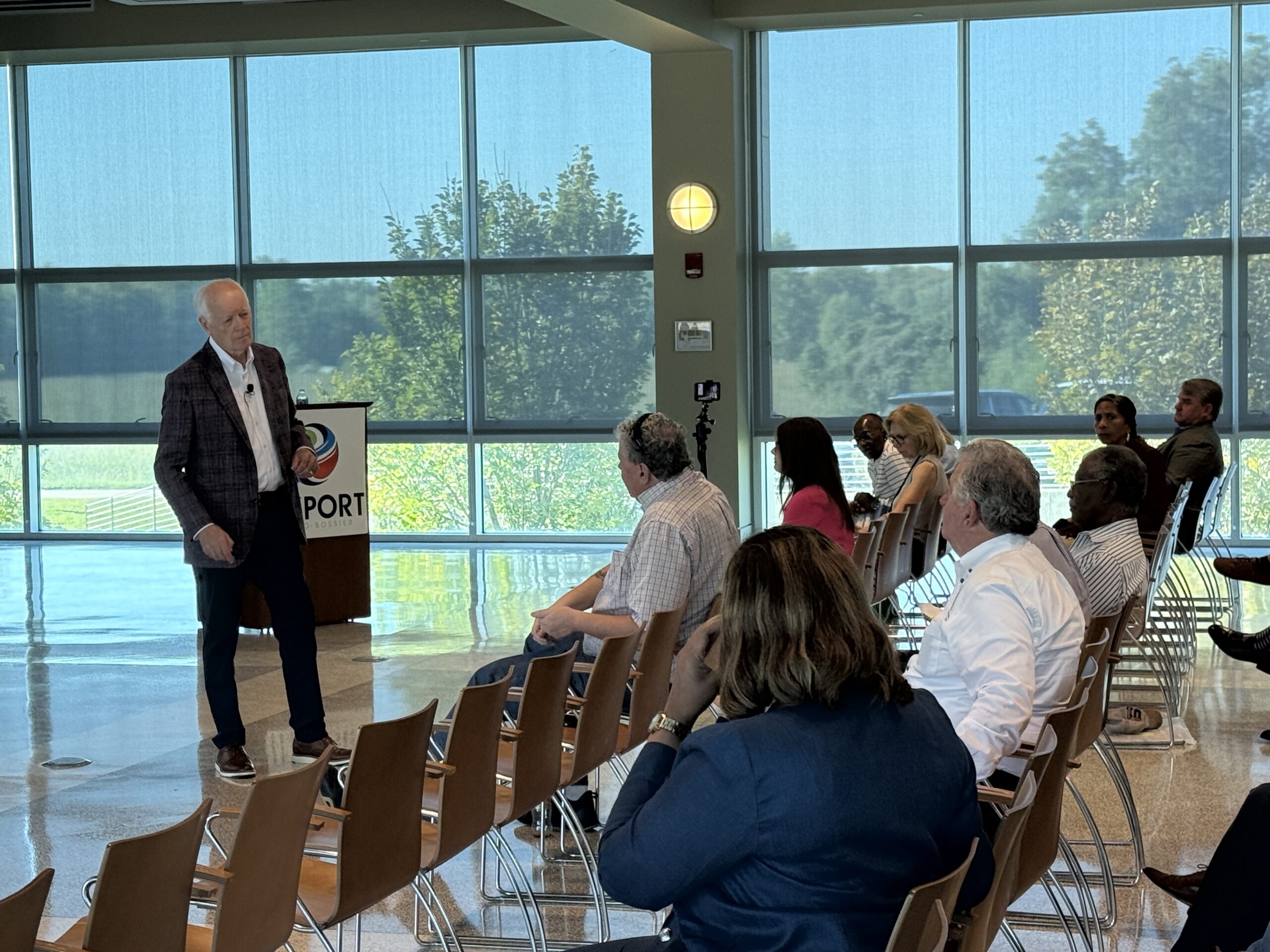
“The Shreveport-Bossier area is fun because there’s a lot of great stuff going up here,” Scott told business and community leaders during his annual economic forecast presentation at the Port of Caddo-Bossier.
Scott projects the Shreveport-Bossier metropolitan area will add approximately 4,800 jobs during 2027 and 2028, placing it fifth among Louisiana’s metropolitan areas for projected job growth.
Amazon changes the scale
Scott left little doubt about which project has most dramatically changed the region’s economic outlook.
“We need to give an award up here to Amazon because, oh my gosh, the amount of money being pumped in here is creating more growth for you,” Scott said. “It is really great.”
He pointed to three planned data centers representing approximately $18 billion in investment, along with Amazon’s existing fulfillment center.
“Eighteen billion dollars in investment. Eighteen billion,” Scott said, emphasizing the scale. “I’ve never come up here and used the word ‘billion’” when discussing investment in the region.
The fulfillment center already employs approximately 2,200 workers, Scott said, with another 300 expected.
But Amazon is only part of the investment picture.
Scott also highlighted SLB’s redevelopment of the former General Motors facility in Shreveport. The company is moving forward with another phase of the facility, with additional investment and employment expected.
“All these huge, great numbers and great investment numbers [are] coming into this area,” Scott said.
Haynesville poised for another surge
The region’s data center growth is occurring alongside another major economic force: increasing demand for natural gas.
Scott said new LNG facilities along the Gulf Coast, combined with power demand from data centers, are positioned to “re-invigorate the Haynesville Shale.”
He offered an anecdotal sign of the activity he saw immediately upon arriving in Shreveport.
“All these pickups are everywhere,” Scott said of the parking lot at his hotel. “And all these guys getting down … they’re all associated with energy companies. In all the years I’ve come up, I’ve never seen anything — I’ve never seen the hotel so full as it was.”
Scott pointed to forecasts calling for significant increases in Haynesville production through 2027 and said pipeline companies are already busy building infrastructure to move natural gas south toward LNG facilities on the Louisiana and Texas coasts.
“This is the closest dry play to those LNG facilities down here,” Scott said. “So this is going to be really good in this area.”
Technology is also changing the economics of producing that gas.
Scott noted that drilling a Haynesville well took approximately 45 days in 2024, while Aethon has reduced that to about 30 days. He also highlighted longer laterals and new drilling techniques being employed by companies including Comstock Resources and BP.
“They’re getting way more efficient,” Scott said.
Port continues to expand
Scott described the Port of Caddo-Bossier as another established economic engine that continues to grow.
“There’s a lot of stuff going on,” he said after describing his drive through the Port. “There’s a lot of stuff going on right here, and it’s continually growing.”
Employment at the Port is currently about 2,300, according to Scott, and is expected to reach approximately 2,400 by 2028.
He also pointed to approximately $80 million in capital investment among Port industries.
Those investments include expansions and equipment projects among companies already operating at the industrial complex, adding another layer of economic activity beyond the region’s headline recruitment announcements.
Scott also discussed a large prospective Port project that remains viable but has not yet reached the point where it can be counted as a certainty.
“This is still a viable project here,” Scott said. “This still has a possibility.”
He said the region should have greater clarity by the end of next year and added that, if it proceeds, “this would be a huge, huge project.”
GDIT renewal a ‘big, big win’
Scott was particularly positive about developments at the National Cyber Research Park in Bossier City.
General Dynamics Information Technology has renewed its lease at the park. Scott said GDIT currently employs about 1,400 people there and is projected to reach approximately 1,600 by 2028.
“This really kind of solidifies one of the biggest employers in our area,” Scott said. “And it’s going to stay there and not move somewhere else. So that was a big, big win for the community.”
Beyond GDIT, Scott said the Cyber Research Park has four projects on the drawing board that collectively could create approximately 850 jobs.
He also highlighted increased federal funding supporting technology and defense-related initiatives at the park, including STRIKEWERX.
Those efforts build upon Northwest Louisiana’s relationship with Barksdale Air Force Base and Air Force Global Strike Command, connecting economic development in the region with defense, cybersecurity and emerging technology.
BRF adds another technology component
Scott also pointed to activity at BRF and its related organizations as another piece of the region’s diversification.
Among the projects he discussed was work involving next-generation radiopharmaceuticals that could create approximately 100 jobs.
“This is a really major change taking place,” Scott said. “Shreveport is kind of the tip of the spear, if you like.”
He also highlighted BRF’s ability to use Other Transaction Authority in working with the Air Force, which can provide a faster pathway for developing and deploying certain technologies.
Scott said the authority can help move promising projects through the federal process more quickly while providing an opportunity to anchor resulting work in Northwest Louisiana.
“That’s a real, real great advantage,” he said.
Growth may be bigger than employment numbers show
One of Scott’s more important cautions was that traditional employment statistics may actually understate the amount of economic activity taking place in Shreveport-Bossier during the coming construction boom.
“If you watch the numbers coming out of the Department of Labor, they are not going to reflect how good things are going on here,” Scott said.
The reason is the enormous number of construction workers required for projects such as Amazon’s data centers and other industrial developments.
Many of those workers may be employed by contractors headquartered elsewhere in Louisiana or outside the region. As a result, their jobs may not be recorded statistically as Shreveport-Bossier employment even while those workers are living temporarily in the area and spending money locally.
“They’re going to that hotel. They’re going to a restaurant,” Scott said. But because their employers may be headquartered elsewhere, “you’re not going to get credit” for all of those workers in the local employment numbers.
Scott suggested a different measure for determining whether that activity is translating into economic gains locally.
“Here’s how you’re going to know,” Scott said. “It’s way better than employment. Look at your sales taxes. Look at your sales taxes. That’s the key.”
That construction activity comes on top of the permanent jobs Scott expects the region to add.
His forecast calls for approximately 4,800 new jobs in Shreveport-Bossier over the next two years, part of an estimated 55,000 jobs statewide.
And for the first time in years, Scott said, North Louisiana is making a meaningful contribution to Louisiana’s growth.
“For the first time in probably two decades, we’ve seen great growth going on north of I-10,” Scott said. “We’ve finally seen some great things going on in Monroe and Shreveport and in Alexandria we’ve never had before.”
For Northwest Louisiana, that represents a significant shift.
The region’s economic story is no longer dependent on one project, one employer or even one industry. Data centers, natural gas, advanced manufacturing, defense and cybersecurity, healthcare technology, Port industries and construction are all contributing to the outlook.
That diversification is a major reason Scott expects Shreveport-Bossier to add thousands of jobs through 2028.
And some of the economic impact may begin showing up in local cash registers and tax collections before it ever appears in the official employment numbers.
Coming next: BIZ Magazine examines the workforce, infrastructure and population challenges that could determine whether Northwest Louisiana can fully capitalize on its new investment.