BATON ROUGE – Anterior cruciate ligament (ACL) tears are one of the most devastating injuries in sports, often requiring a year for an athlete to return to competitive play.
Consider that Louisiana faces additional risk because of high childhood obesity rates, which increase joint stress, and the problem looms even larger here at home.
So when a trio of LSU Shreveport computer science students had an opportunity to work on digital solutions for ACL injury prevention and recovery as part of the DevDays HealthTech Challenge, there was no hesitation.
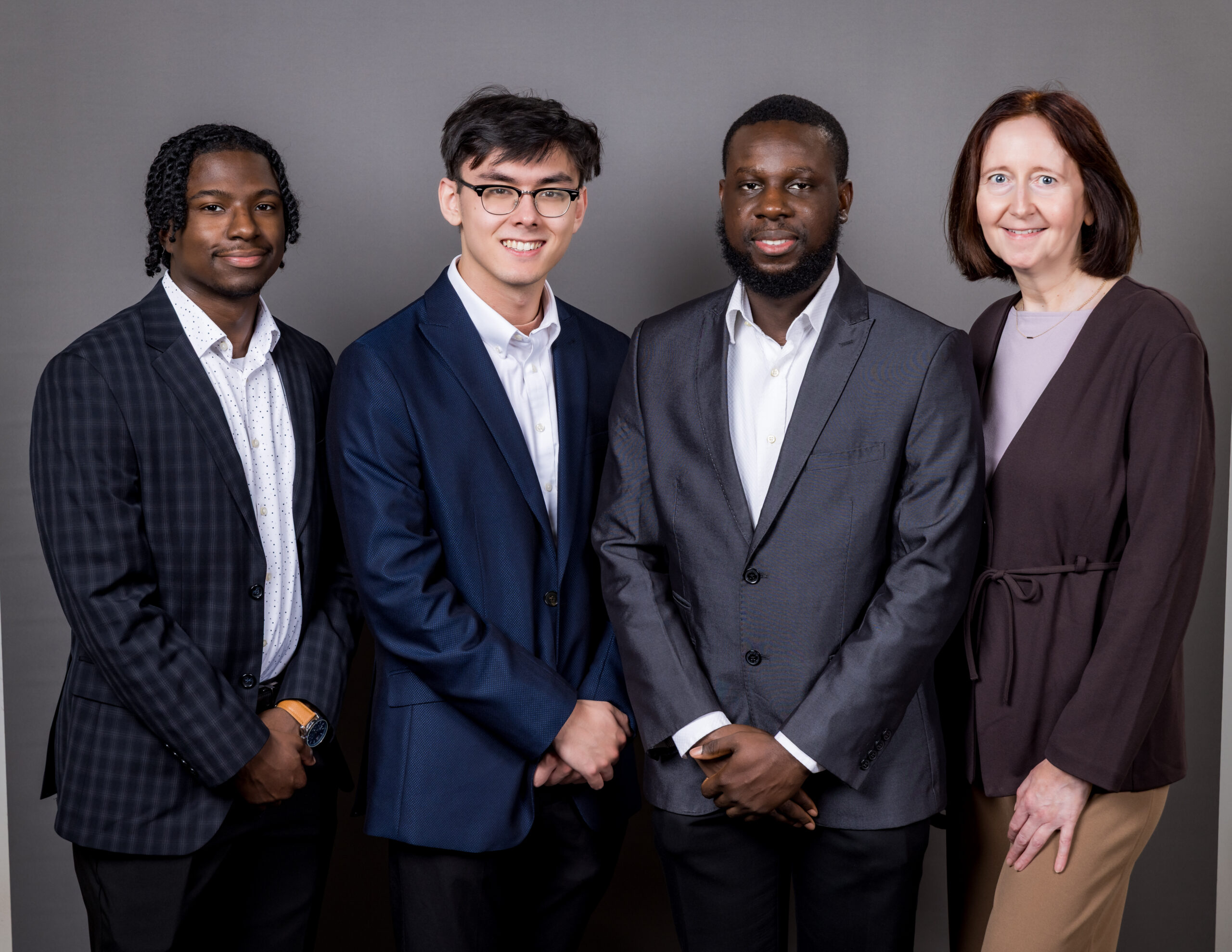
The Smartknee team from LSUS were finalists in the challenge, in which they created a wearable prototype that could provide real-time data on high-risk movements that athletes make and the ensuing joint stress.
LSU Baton Rouge hosted the competition this past month.
“These students sprung into action and designed a working prototype that was based on sensors, presenting a low-cost wearable system that measures 3D knee joint kinematics and calculates ACL risk in real time using dual inertial measurement units,” said Dr. Urska Cvek, an LSUS computer science professor and faculty advisor for this project.
Graduate student Augustine Nwafor put his background as an embedded systems engineer to use while computer science undergraduates Ricky Wiggins Jr. and Stewart Greathouse focused on the software layer and application interface.
“The system operates on two levels,” Nwafor said. “There are real-time alerts that notify coaches immediately when an athlete performs a high-risk movement – like dangerous cutting angles or poor landing mechanics.
“The system also has predictive power from cumulative tracking. The dashboard maintains each athlete’s risk history over rime, and an integrated (artificial intelligence) assistant helps coaches interpret patterns. If an athlete accumulates multiple risky landings in a short period, that’s a red flag for fatigue-related injury susceptibility.”
The team received a major assist from LSU Health Shreveport’s Dr. Giovanni Solitro, the director of the biomechanics educational laboratory who investigates the biomechanics of various joints.
“As a biomechanical engineer and professor of orthopaedic surgery, he brought the clinical perspective we needed,” Nwafor said. “He educated us on ACL injury mechanisms, the biomechanics of what actually causes the tear, and he guided our technical approach to ensure our measurements aligned with established clinical standards.
“Without his domain expertise, we might have built something technically impressive but clinically irrelevant.”
Perhaps the most impressive part of this project and its finalist status is that the LSUS team didn’t discover the competition until more than halfway through the six-week timeframe.
“The core idea of using two inertial measurement units came from Dr. Solitro, but turning it into a working, real-time system in essentially 48 hours was all execution,” Nwafor said. “Firmware, sensor fusion, and Bluetooth Low Energy stacking are home territory for me, even though I had never touch inertial measurement units or quaternion math before.
“Two all-nighters, a lot of Stack Overflow and the original ISB papers got us from raw acceleration/gyro data to accurate 3D knee valgus/varus angles in real time. The fact that we were the only team with a live, on-stage demo of a hardware device while others showed slides or pre-recorded videos felt like the ultimate proof that we belonged on that stage.”
The competition, which was organized by Nexus Louisiana in partnership with Ochsner Health and drew 47 college teams from 11 different universities around the state, didn’t require a fully developed solution. A prototype, a mockup, or a coded demo that demonstrated the approach, problem solving skills, and potential impact was the hurdle to clear for entry.
“Doing such research projects gives our students a bridge between theory and practice, helping students understand how concepts are applied in real-world situations,” Cvek said. “The ability to present to industry representatives creates opportunities to meet potential employers, future mentors and collaborators.”
The team plans to continue the research and product development under Cvek’s tutelage.
“This experience has defined my current career path as I continue to work in Dr. Cvek’s lab as a graduate research assistant,” Nwafor said. “Our next phase is to train AI to classify specific movement types, like jumps vs. cuts, and recommend targeted corrective drills.
“So if an athlete repeatedly demonstrates poor landing form, the system won’t just alert – it’ll suggest specific exercises to address that biomechanical weakness. My ultimate goal is to translate this research into a commercially viable product. There is a massive gap in the market for low-cost, preventative wearables. If we can help young athletes avoid injury or return to sport safely without breaking the bank, that’s a legacy I want to be a part of.”