
By Julie O’Donoghue | Louisiana Illuminator
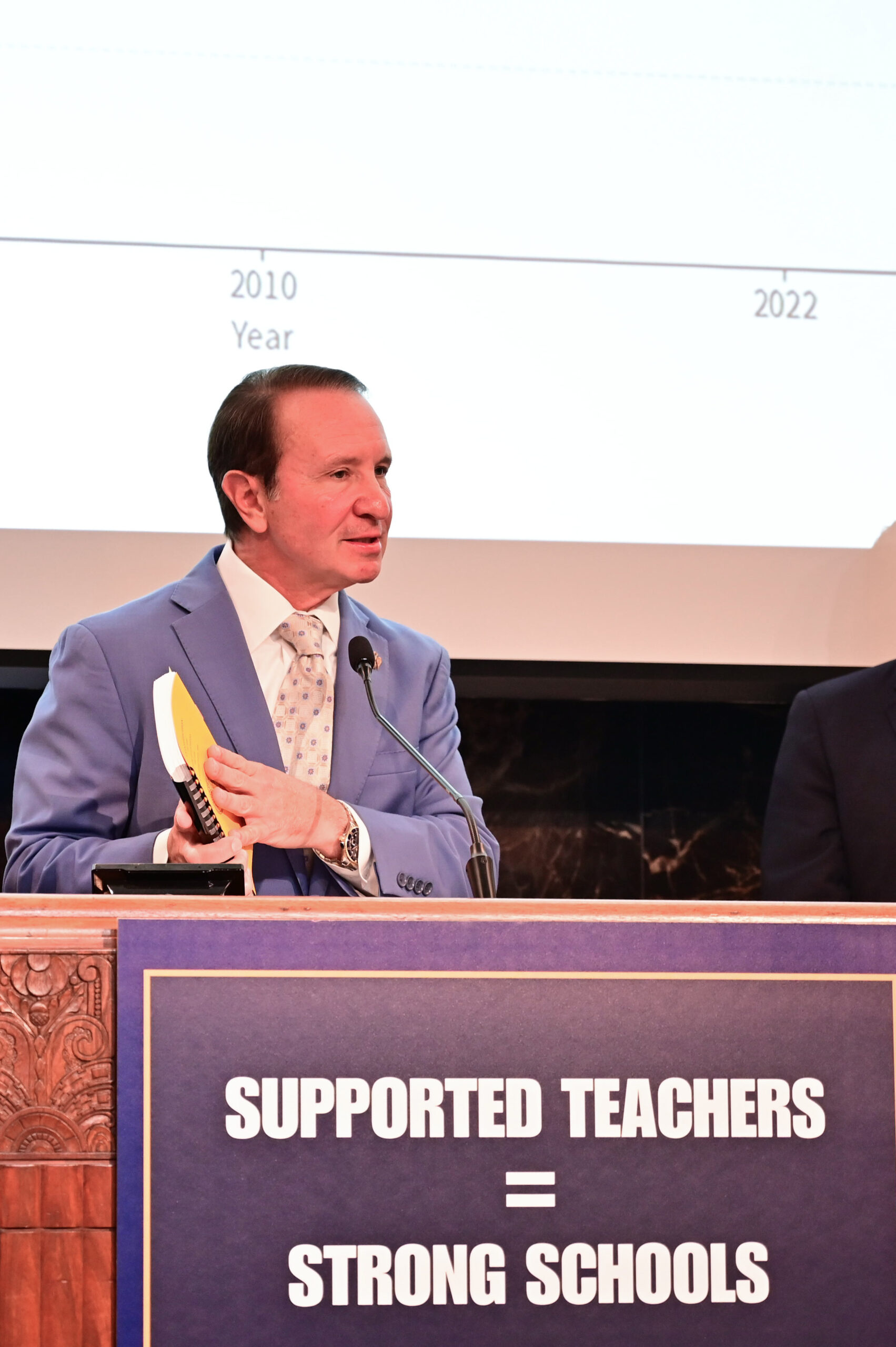
A Baton Rouge judge has temporarily halted Gov. Jeff Landry’s plan to cut $168 million from K-12 public school operations to pay for another round of teacher stipends.
Judge Richard “Chip” Moore, a Republican on the 19th Judicial District Court, said the governor’s proposal, upon an initial review, could be “manifestly unconstitutional.” He issued a temporary restraining order Thursday in response to a lawsuit three longtime education advocates filed to block Landry’s plan.
Moore barred the lawsuit defendants — including the Landry administration, state education department and Treasurer John Fleming — from working to implement any part of the governor’s proposal until after a June 29 court hearing. Landry’s plan is supposed to take effect July 1.
It’s not clear the judge’s order can stop a crucial step in the process: the Louisiana Legislature’s vote on the governor’s proposal.
If approved by lawmakers, the governor’s plan moves money out of a fund for K-12 school operations and into teacher and school support staff stipends worth $2,000 and $1,000, respectively.
Legislators were expected to cast ballots on the proposal by 5 p.m. Tuesday. The governor needs two-thirds of the members in each chamber to advance his plan.
Moore’s order temporarily prevents defendants from “efforts to obtain written consent from two-thirds of elected members of each house of the Legislature.”
But the legislature was not a defendant in the lawsuit, and lawmakers are carrying out their own voting process.
“Not sure a judge can stop us from a legislative act,” House Republican Caucus Chairman Michael Echols, R-Monroe, wrote in a text Thursday night.
In a statement, Attorney General Liz Murrill said the temporary restraining order should never have been issued.
“The TRO has no effect whatsoever on the legislative ballot process. The legislature is not (and cannot be) a defendant,” Murrill said.
Greg Beuermann, a spokesman for the lawsuits’ plaintiffs, said legislators might be able to vote, but it would largely be an “academic exercise” because the judge’s order blocks Landry’s entire plan from moving forward.
“Plaintiffs believe the ruling protects both Louisiana’s constitutional separation of powers and the transparency the public deserves when decisions are made about K-12 education funding,” Beuermann wrote.
The governor’s office did not respond to a request for comment about Moore’s order. Earlier in the day, in response to the lawsuit being initially filed, Landry’s spokeswoman Elizabeth Crochet had said the governor was “very confident” in his legal position.
Senate President Cameron Henry, R-Metairie, declined to comment on Moore’s order, and House Speaker Phillip DeVillier, R-Eunice, did not respond to a text message or phone call.
Legal arguments
Besides Landry, Louisiana’s Department of Education, state Education Superintendent Cade Brumley, Louisiana’s Division of Administration, Commissioner of Administration Taylor Barras, Louisiana’s Department of Treasury and Fleming are the lawsuit’s defendants. The plaintiffs are former school superintendent Michael Faulk, former state school board member Belinda Davis and current Orleans Parish School Board member Katherine Baudouin. In issuing the temporary restraining order, Moore was swayed by the plaintiffs’ allegations that Landry lacks the constitutional authority to reduce and move around education funding.
“It oversteps the Executive Branch’s limited constitutional power to reduce MFP appropriations by also redirecting the same reduced appropriation to the purpose of its choosing,” Moore wrote.
The plaintiffs contend Landry is impinging on the powers of the legislature, which creates the state’s budget, and the Board of Elementary and Secondary Education, which creates the school funding formula.
They also question whether lawmakers should be allowed to vote remotely for the governor’s plan.
“The virtual ballot procedure substitutes a private, individual, online vote without committee hearing, without floor debate, without public testimony, without amendment, and without any mechanism for public participation or transparency for the deliberative process the Constitution requires for the disposition of public funds,” the advocates said in their lawsuit.
The governor and lawmakers are scrambling to find a way to avoid a teacher pay cut after a constitutional amendment they backed failed on the May 16 ballot. It would have freed up state funding for a permanent teacher and school staff pay raise to replace the stipends educators and school staff have received for the past three years.
Landry has repeatedly said he believes school districts can absorb the cuts to their operational funding for expenses such as facility upkeep and insurance. School superintendents and school board members from across the state have criticized the proposal as impractical and difficult to adopt.