
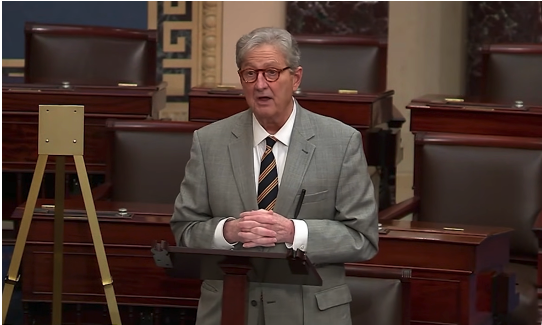
WASHINGTON — Sen. John Kennedy introduced legislation aimed at preventing the U.S. Treasury Department from collecting certain personal information from small business owners, citing concerns about regulatory burden and privacy.
The bill would limit enforcement of reporting requirements established under the Corporate Transparency Act, which mandates that certain businesses submit Beneficial Ownership Information, including names, dates of birth, addresses and identification numbers, to the Treasury’s Financial Crimes Enforcement Network.
Kennedy, a member of the Senate Banking Committee, said the measure seeks to eliminate what he described as unnecessary data collection.
“When an obscure government policy requires small business owners to fork over personal data that even our government admits it doesn’t need, it’s time to change that policy,” Kennedy said.
The legislation is co-sponsored by Sens. Roger Marshall, Mike Lee, Ted Cruz, Marsha Blackburn, Shelley Moore Capito, Jim Justice, Tim Sheehy, Pete Ricketts and Jim Banks.
Supporters of the bill argue that the reporting requirements impose compliance costs and divert resources from business operations. Marshall said small business owners in Kansas have raised concerns about the cost and complexity of the requirements, while Lee said the rules place unnecessary administrative and privacy burdens on business owners.
Under the Corporate Transparency Act, enacted in 2021, businesses are required to report ownership information to the Treasury’s Financial Crimes Enforcement Network, known as Financial Crimes Enforcement Network. The agency later determined that aspects of the reporting requirements were overly burdensome for small businesses.
In March 2025, FinCEN issued a rule narrowing the scope of the reporting requirement to foreign reporting companies, effectively pausing data collection for many U.S. businesses.
Kennedy’s bill would codify that rule into law and require the deletion of previously collected data from U.S. business owners.
According to the bill’s sponsors, the changes would reduce compliance costs, with estimated savings of $9 billion annually for taxpayers and $6.7 billion over 10 years for small businesses.
The legislation is supported by the National Federation of Independent Business.