
By Maia Tyler | LSU Reveille
BATON ROUGE–Former Gov. John Bel Edwards said Wednesday that he does not plan to re-enter politics, though he would not rule that out completely.
Edwards, a Democrat, said many people pushed him to run for the U.S. Senate this year. But he said he is enjoying the freedom of living with his wife and being a private citizen.
“I’m not interested in being in Congress, now and probably ever, but I won’t say that I’ll never run for public office again,” Edwards said.
Democrats wanted Edwards to run against U.S. Senator Bill Cassidy, a Republican, this year. While he did not comment on running for governor again, most political analysts see him as the only Democrat who could potentially unseat Republican Gov. Jeff Landry in 2027.
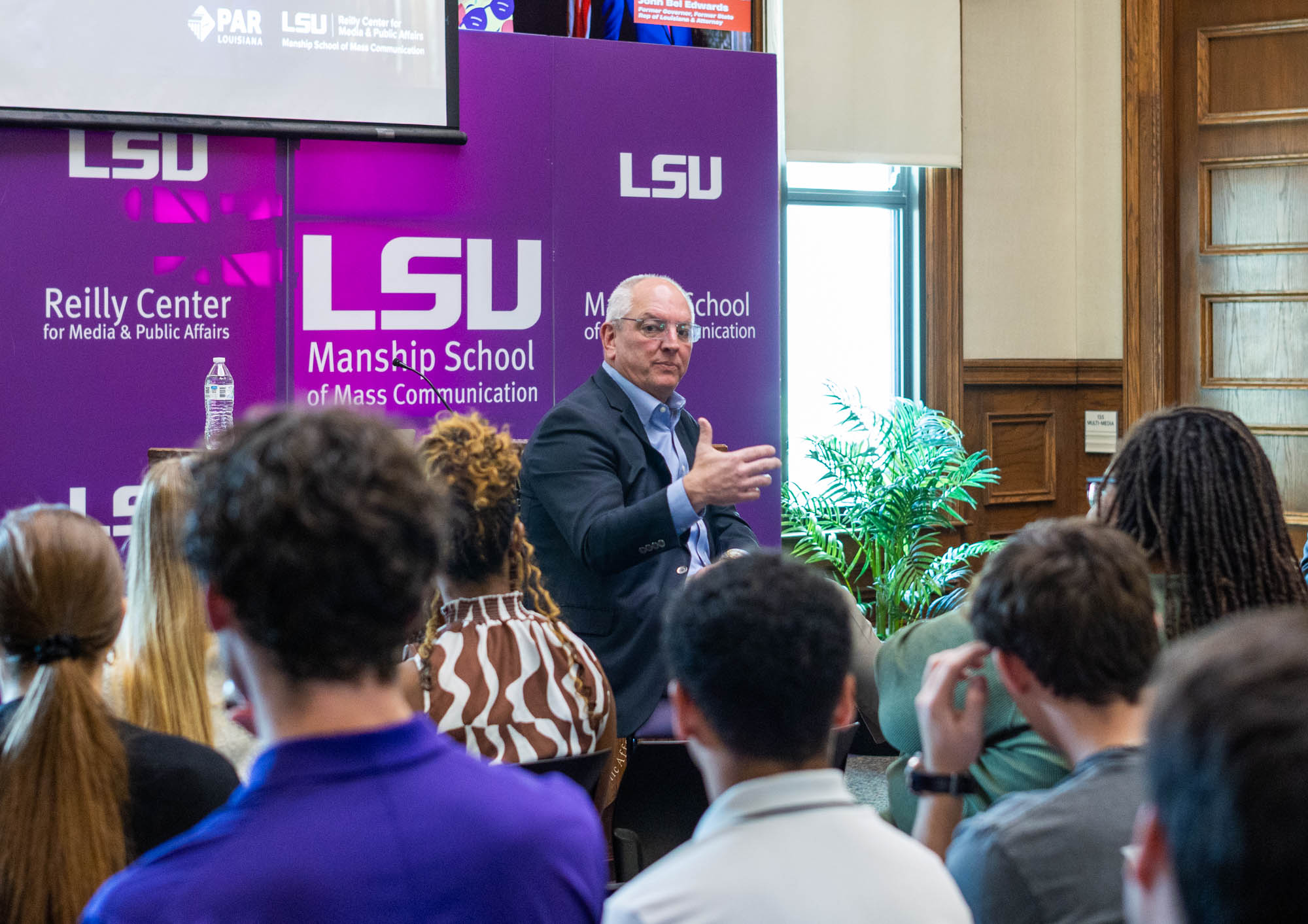
Edwards made the comments at a pizza lunch with LSU students on Wednesday.
The lunch was one of a series hosted by the Reilly Center for Media and Public Affairs at the Manship School of Mass Communication. The events allow students and faculty to engage in discussions with public officials and civic leaders.
Edwards, who served as Louisiana’s governor from 2016 to 2024, was invited to share insights on achieving policy outcomes through coalition-building and effective communication.
He attributed his political inclination to his family’s legacy, particularly his father’s role as a parish sheriff. He recounted his journey from West Point and eight years of active duty in the U.S. Army to LSU’s law school.
In discussing his experience as a Democrat in a traditionally conservative state, Edwards reflected on how his party affiliation influenced his election campaigns, noting that some of his positions diverged from the national party’s platform.
“When I won in 2015, the Democratic Party for the country was talking about how it demonstrated that a Democrat could win statewide in the Deep South,” Edwards said. “They were talking about being a big tent party … but then when you actually govern the way you said you were going to govern, you get criticized a whole lot, and you realize maybe the big tent is something they talk about, but not something they really want to practice as much.”
Edwards’ first year in office came with a lot of tensions and emergencies, including the historic 2016 floods in Baton Rouge and the police shooting of Alton Sterling. The rest of his terms brought more crises, from natural disasters to the COVID-19 pandemic.
He had to navigate federal disaster management and funding requests with three presidents from different parties. Along with assistance for natural disasters, Edwards said he went to Washington to ask for funding related to healthcare, education and infrastructure.
“I knew that I was going to be governor of a state that was going to have plenty of needs,” Edwards said. “If I was going to be the best, most effective governor I could be, I needed to have a good relationship with the president.”
Edwards voiced that while he was in office, he did not want to unjustifiably a the president by going on national news to be critical, which is something he said he was asked to do all the time during the first Trump administration.
He said his reasoning for this was not because always agreed with everything revolving around the sitting president but because he recognized that having a cordial relationship with the president was necessary to get assistance for the state.
“When I won reelection, … I told [President Donald Trump] that the election was over and I was going to be governor for four more years, and that it was just time to forget about the election and start working together the best we could,” Edwards said. “I had that in common with all of them, but it was even more important with President Trump because he can be a very vindictive person.”
The Journalism Building was packed with students, faculty and staff coming to hear what Edwards had to say and ask him questions. The event went over its hour-long time frame due to the surplus of inquiries by the audience.
“I really enjoyed how [he] came and was really authentically himself,” said Akeyna Travis, an economics freshman. “I really appreciate him sitting down and having a conversational interaction with us rather than just sitting and talking at us or lecturing us.”