
BOSSIER CITY, La. — Northwest Louisiana enters the next phase of its economic development with growing healthcare, technology, transportation and defense sectors, alongside billions of dollars in new investment that are reshaping the region’s infrastructure and workforce needs.
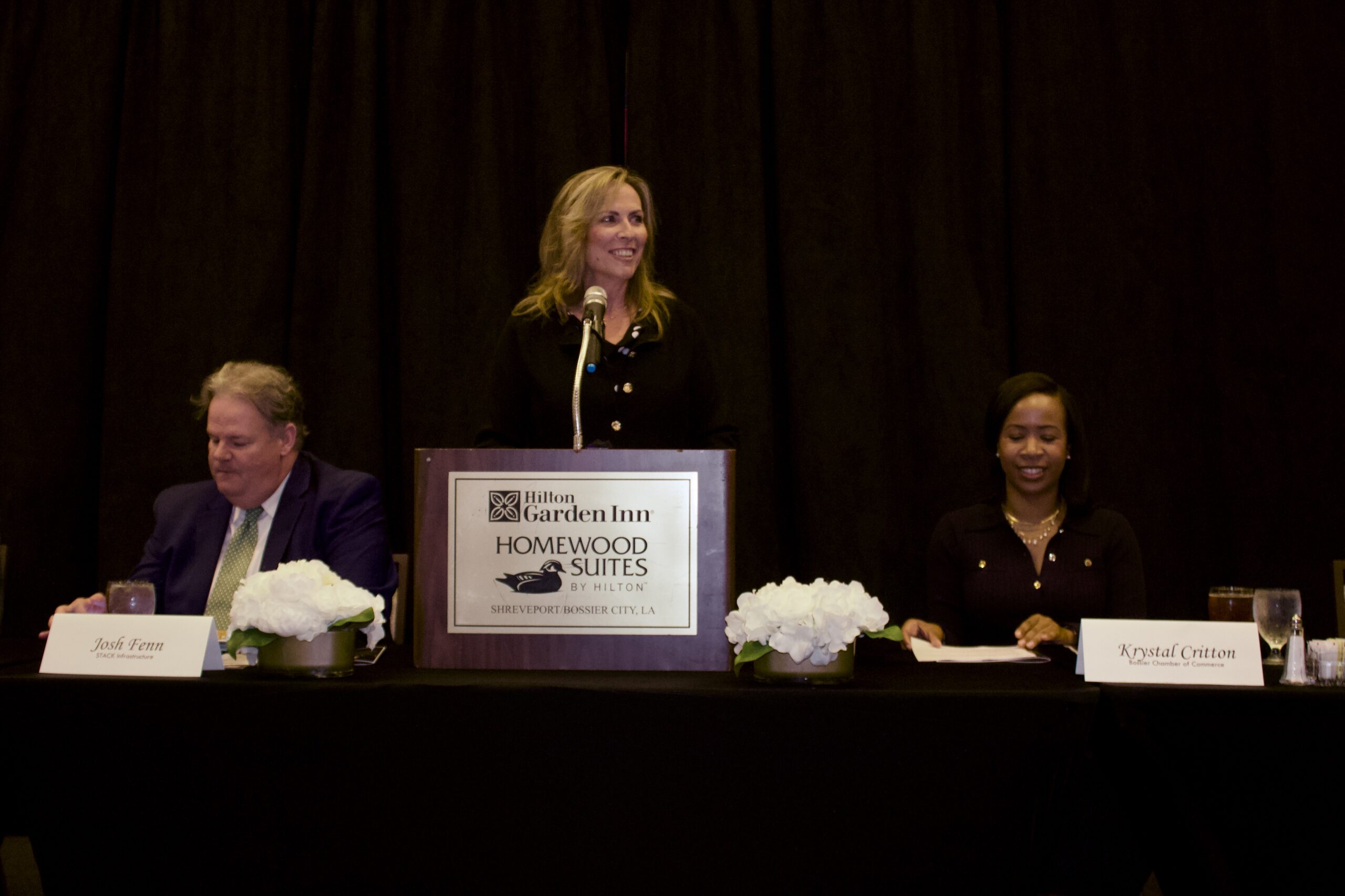
Those trends were highlighted Monday as the Bossier Chamber of Commerce presented its 2026 State of the Community Report event, the fifth edition of an annual examination of Northwest Louisiana’s economic strengths, challenges and opportunities.
“Today is not only about celebrating what has happened,” Bossier Chamber President and CEO Lisa Johnson told attendees. “It is also about asking what these numbers mean for the people who live and work here.”
The report tracks healthcare, energy, transportation, defense, cyber and technology, and education while examining how the region has changed during the past five years.
Its conclusion is not simply that Northwest Louisiana has grown. The scale of the opportunities confronting the region has changed.
“What once looked like major wins in the hundreds of millions has grown into multi-billion-dollar investments, bringing new attention to infrastructure, workforce, and local participation in regional growth,” the report states.
Healthcare remains a major economic engine
Healthcare continues to rank among Northwest Louisiana’s largest economic sectors.
Healthcare sector earnings in Caddo and Bossier parishes increased nearly 18% over the period highlighted in the report, growing from approximately $2.12 billion to $2.5 billion.
The LSU Health Shreveport and Ochsner LSU Health partnership generated an estimated $3.7 billion in statewide economic impact during fiscal year 2025, with $3.6 billion remaining in the North Louisiana economy.
The partnership directly employs 6,662 people and supports an additional 18,652 regional jobs, according to figures included in the Chamber report.
Healthcare employment is projected to reach 27,424 jobs by 2035, an increase of 8.1%.
Energy shifts toward infrastructure and data centers
Northwest Louisiana’s energy story is also changing.
The Haynesville Shale remains a major natural gas resource, but the report points to increasing demand from LNG exports, electric generation, data centers and industrial development as factors placing greater importance on power generation and infrastructure.
The report identifies approximately 175 trillion cubic feet of recoverable natural gas in the Haynesville Shale and describes the combination of natural gas, available industrial sites, transmission capacity, pipelines and transportation infrastructure as a competitive advantage for future investment.
For Shreveport-Bossier, the Chamber argues, energy is increasingly becoming a site-readiness and infrastructure issue in addition to a production industry.
That shift is particularly significant as Northwest Louisiana develops into a major data-center market.
Amazon has announced $18 billion in planned data-center investment across Northwest Louisiana. The report says the projects could create up to 750 direct jobs across three campuses, while Louisiana Economic Development estimates another 1,784 indirect jobs.
STACK Infrastructure expects as many as 2,250 construction jobs associated with its development, while up to $400 million in public water infrastructure is planned in connection with the region’s data-center growth.
Transportation investments strengthen regional connections
The Chamber report also highlights major transportation investments completed or underway across Northwest Louisiana.
The $128 million rehabilitation of Interstate 20 through Bossier City was completed this year after construction that began in 2023.
Work continues on the $361.7 million Jimmie Davis Bridge replacement and rehabilitation project, which includes a new four-lane bridge across the Red River, widening and reconstruction of Louisiana Highway 511 and pedestrian and bicycle infrastructure.
At the Port of Caddo-Bossier, the report cites 468,428 tons of waterborne freight, 771,110 tons by rail and approximately 1.65 million tons of inbound and outbound truck traffic.
The Port also has approximately $80 million in capital investment ahead and is projected to support 2,392 tenant jobs by 2028.
Shreveport Regional Airport recorded its highest passenger traffic in 45 years during 2025, exceeding 800,000 passengers. That represented a 12% increase from 2024 and pushed passenger levels above pre-pandemic traffic.
Cyber growth creates workforce challenge
One of the report’s clearest examples of both opportunity and challenge is Northwest Louisiana’s growing cyber and technology sector.
Regional cybersecurity employment increased from 1,854 jobs in 2024 to 2,102 in 2025 and is projected to reach 2,885 jobs by 2027.
But the report estimates the Shreveport-Bossier area currently has enough cybersecurity workers to meet only 73% of local employer demand.
That gap places additional importance on regional education and workforce programs.
Louisiana Tech University and the Louisiana Tech Research Institute’s Cyber Technology Practitioner Program grew from 24 participants in 2024 to 60 students during the first quarter of 2026, a 150% increase.
Bossier Parish Community College also serves as a regional cybersecurity training hub through its presence at the National Cyber Research Park in Bossier City.
Region looks toward next five years
The State of the Community event also included a panel discussion featuring Servando Esparza of Amazon Web Services, North Louisiana Economic Partnership President and CEO Justyn Dixon and F.J. “Josh” Fenn of STACK Infrastructure discussing major technology investment and its implications for Northwest Louisiana.
Krystal Critton, the Chamber’s director of Community Business Development and curator of the report, said the changes documented during the initiative’s first five years demonstrate the region’s momentum.
“Healthcare has grown. Barksdale remains a powerful economic anchor. Our cyber ecosystem has expanded. Airport traffic has grown. Major infrastructure projects have moved from plans to completion,” Critton said. “Northwest Louisiana is attracting a scale of new investment that would have been difficult to imagine when this report began five years ago.”
But Chamber leaders emphasized that the report is also intended to identify where Northwest Louisiana has work to do.
It points to expanding quality jobs, improving workforce participation, increasing household income, reducing poverty, strengthening infrastructure and creating stronger pathways to opportunity among the areas requiring continued attention.
The report describes the region’s workforce, infrastructure, institutions, natural resources, military presence and partnerships as providing a strong foundation for future growth, while calling for continued collaboration and investment.
“Our assets are real. Our potential is significant,” wrote Andrew D’Avy, chair of the Bossier Chamber Community Sustainability Committee. “Our next chapter depends on how we choose to advocate, innovate and invest together.”