
(The Center Square) – After spending much of 2025 pitching regulators on major projects to prepare for rising electricity demand, Entergy is set to return with more of the same in 2026.
The New Orleans-based utility has filed for another major project in south Louisiana currently projected to cost over $1 billion, 82% of which would be shouldered by ratepayers. In filings with the Louisiana Public Service Commission, Entergy said it could cause residential bills to rise by $3.47, but that estimate is not complete and could be revised. The project includes a 145-mile, 500-kilovolt line that Entergy says will improve reliability and resilience for residents and will be completed by August of 2029.
Entergy also is seeking approval to build and upgrade infrastructure for businesses moving into the state. It plans to build new transmission to support a recently announced $10 billion data center in West Feliciana Parish that is expected to demand around 345 megawatts of electricity. The costs of building the transmission remain uncertain.
The utility’s plans will test regulators’ abilities to balance building electricity infrastructure for big-ticket clients while protecting ratepayers from rising costs.
A utility must recover the costs of building the infrastructure that serves it, either by hiking rates for residents and companies or by forcing the incoming business to pay for it. Meta, for instance, has agreed to cover much of the cost of the electricity infrastructure Entergy plans to build for its giant data center in northeast Louisiana.
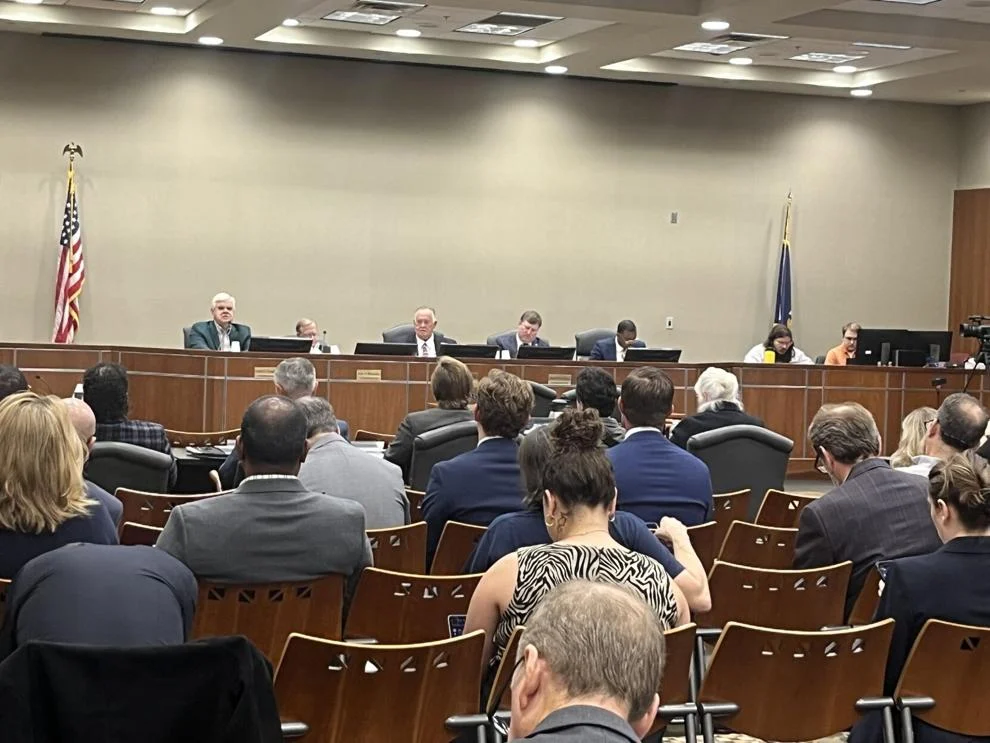
Entergy spent hours testifying before the Public Service Commission in 2025, detailing the infrastructure needed to support various companies looking to move to Louisiana. Regulators approved several upgrades to serve Meta’s data center and Hyundai’s $6 billion steel mill. Other major investment’s coming include a billion-dollar ammonia facility, an electric vehicle battery manufacturer and an aviation fuel factory, among others.
In the industrial corridor between Baton Rouge and New Orleans alone, Entergy has over 2,600 megawatts of load under study.
These industrial projects, according to Entergy, will provide tax dollars, jobs and help grow the state’s economy. In almost every request to build new electricity infrastructure in 2025, Entergy asked regulators to deem the project to be in the public interest.
If the Commission agrees, the costs can be deemed eligible for recovery through ratepayers, a ruling backed by the Louisiana Supreme Court.
“To fully realize the economic opportunity that these projects represent for Louisiana, Entergy must move forward with construction of the transmission facilities required to provide reliable service,” Michelle P. Bourg, Entergy’s vice president of business and economic development, said in testimony to the Commission.
The Commission has tended to agree. In December, regulators approved a directive that would exempt certain utilities from various ratepayer protections to handle the power needs of major industrial projects.
The order, meant to support Gov. Jeff Landry’s “Lightning Speed” initiative to lure companies to Louisiana, would allow utilities an expedited timeline for approval. It would also potentially leave ratepayers more exposed to the costs of the upgrades.
The order drew scrutiny from watchdog groups, including the Pelican Institute for Public Policy, which has generally supported Landry’s initiatives.
“While the stated goal – attracting major employers while protecting consumers – is broadly shared, the policy mechanics under consideration raise serious questions,” the organization said in a statement. “Research on transmission monopolies and similar expedited frameworks shows that suppressing competition can increase costs, slow innovation, and weaken accountability, leaving customers exposed to decades of higher bills.”
Minutes after voting on the order, the Commission deferred a separate one from Commissioner Davante Lewis to develop a framework for large-load customers that would examine issues like cost-sharing, reliability and consumer protections.