
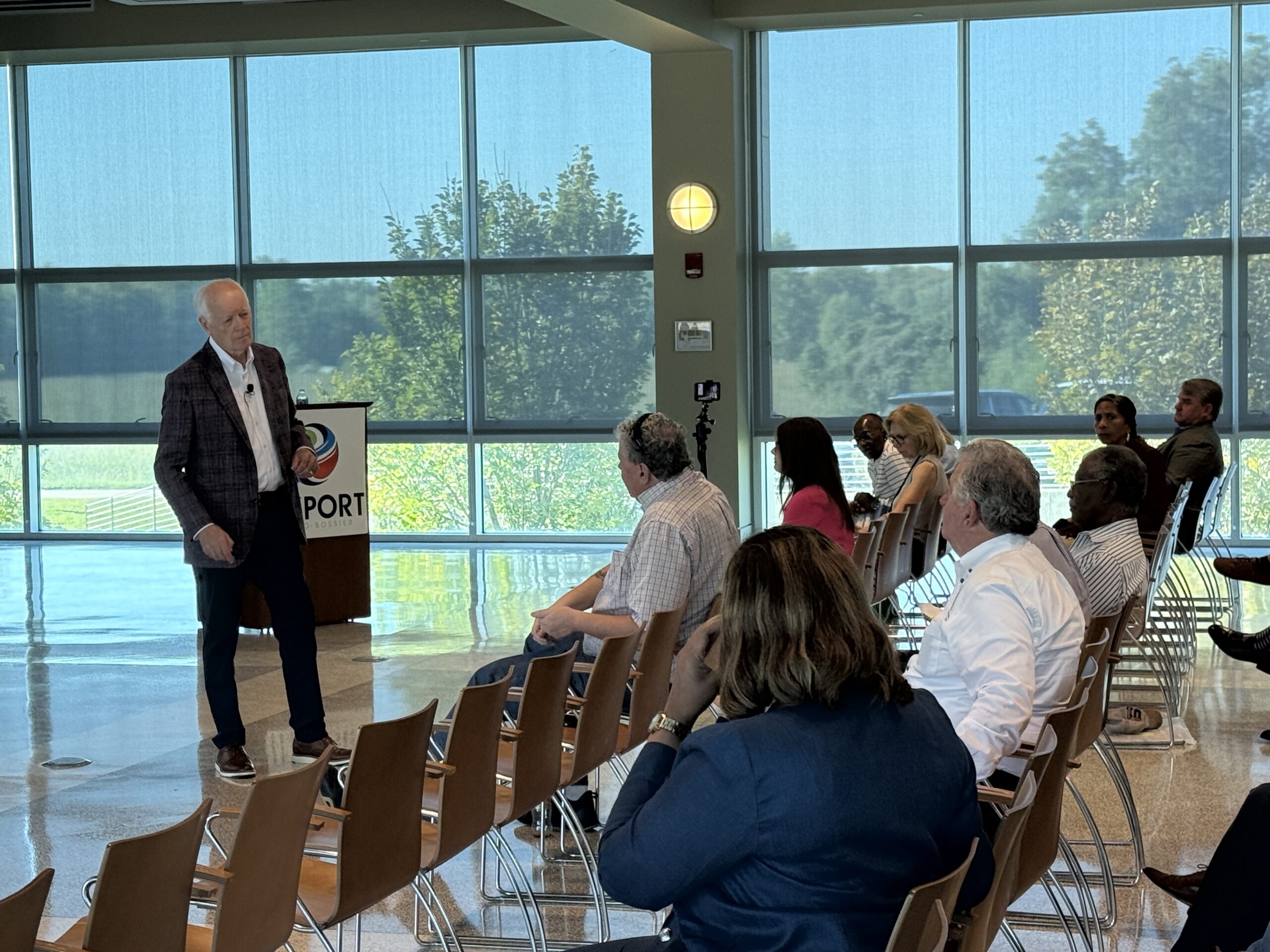
Editor’s note: This is the final installment in a BIZ Magazine series examining economist Loren Scott’s 2027-28 forecast for Northwest Louisiana, the projects driving the outlook and the challenges that could shape whether the region realizes that growth.SHREVEPORT, La. — Northwest Louisiana has spent years trying to attract the kind of investment now flowing into the region.
The next challenge may be finding enough people to build it, operate it and turn billions of dollars in announced projects into lasting economic growth.
Economist Loren Scott is forecasting the Shreveport-Bossier City metropolitan area will add approximately 4,800 jobs over the next two years, placing the region fifth among Louisiana’s metropolitan areas for projected job growth.
That forecast comes as Amazon develops its $18 billion data center investment, existing industries expand at the Port of Caddo-Bossier, technology employment grows in Bossier City and additional manufacturing, energy and technology projects remain in the development pipeline.
But the region enters that expansion from an unusual position: investment is accelerating even as its population base has been shrinking in parts of the metropolitan area.
The latest U.S. Census Bureau estimates put Caddo Parish’s population at 224,226 in 2025, down 5.8% from its 2020 estimates base. Shreveport’s estimated population declined 6.2% during the same period, to 175,902.
Bossier Parish moved in the opposite direction, growing 2.5% from its 2020 estimates base to an estimated 131,867 residents in 2025.
That uneven population picture could become increasingly important as employers compete for construction workers, skilled trades, engineers, technology workers and employees to fill permanent positions created by the region’s new investment.
Growth may not immediately show up in the numbers
Scott cautioned that the scale of the activity underway in Northwest Louisiana may be difficult to see in traditional employment statistics, particularly during the construction phase.
“If you watch the numbers coming out of the Department of Labor, they are not going to reflect how good things are going on here,” Scott said.
The reason, he explained, is the enormous number of construction workers required for projects such as the data centers. Contractors working in Northwest Louisiana may be headquartered elsewhere, meaning their employees can be counted outside the region even while those workers are spending money locally.
Scott cited contractors headquartered in Baton Rouge as an example. Their workers may be staying in local hotels, eating at local restaurants and making other purchases in Shreveport-Bossier while their employment is recorded elsewhere.
That makes another economic indicator particularly important.
“Look at your sales taxes,” Scott told the audience. “Look at your sales taxes. That’s the key.”
The distinction could become increasingly visible as construction on large projects accelerates.
Federal labor statistics already show some of that momentum. Construction employment in the Shreveport-Bossier City metropolitan area reached about 10,000 jobs in August, up 12.4% from a year earlier. Manufacturing employment was also up 5.1% year over year.
Overall nonfarm employment, however, was up only 0.3%.
Those numbers illustrate Scott’s point: the headline employment figure may not immediately capture the scale of investment occurring beneath it.
A tighter labor equation
The region’s civilian labor force stood at approximately 170,800 in August, with about 164,600 people employed and an unemployment rate of 3.6%.
A relatively low unemployment rate combined with thousands of projected new jobs creates a basic economic question: Where will the additional workers come from?
Some will come from people already living in Northwest Louisiana who move into new jobs or acquire new skills. Others may commute from surrounding parishes or East Texas. Major construction projects will also bring temporary workers into the market.
Longer term, however, sustaining the expansion will require Northwest Louisiana to retain more of its existing population and attract workers from outside the region.
That makes workforce development more than an education issue. Housing, infrastructure, schools, quality of life and the region’s ability to recruit and retain young professionals all become part of the economic-development equation.
The challenge also varies considerably across the metropolitan area.
Bossier Parish’s population growth gives the region one source of additional workers and consumers, while the continuing population losses in Shreveport and Caddo Parish demonstrate how much ground remains to be recovered.
New jobs could help change that trajectory — particularly if they offer wages and career opportunities capable of keeping graduates in Northwest Louisiana and attracting former residents back to the region.
A different Northwest Louisiana economy
Scott’s forecast also suggests the composition of the regional economy is changing.
For decades, Northwest Louisiana’s economic fortunes have been closely associated with energy, gaming, healthcare, manufacturing and Barksdale Air Force Base.
Those industries remain important. But the current investment cycle adds data centers, artificial intelligence infrastructure, cybersecurity, defense technology and other technology-related activity to the mix while simultaneously generating new investment in energy and advanced manufacturing.
Scott said that change is part of a broader shift occurring across northern Louisiana.
“For the first time, in probably two decades, we’ve seen great growth going on north of I-10,” Scott said, pointing specifically to developments in Monroe, Shreveport and Alexandria.
For Shreveport-Bossier, the significance goes beyond any single project.
Amazon’s investment is enormous, but Scott’s forecast does not rest on Amazon alone. Existing Port industries are investing. General Dynamics Information Technology has renewed its presence at the National Cyber Research Park. Other prospects could add hundreds of additional jobs. Energy and manufacturing projects remain in the pipeline.
Together, they create something Northwest Louisiana has lacked during previous economic cycles: multiple potential sources of growth occurring at roughly the same time.
That also raises the stakes.
Landing a major project generates headlines. Turning it into decades of economic growth requires workers, suppliers, infrastructure and communities capable of supporting it.
For Northwest Louisiana, that may be the real test of the next several years.
Scott’s forecast suggests the opportunity is already arriving.
Whether the region can supply the people needed to capture it may determine how much of that opportunity remains after the construction cranes are gone.