
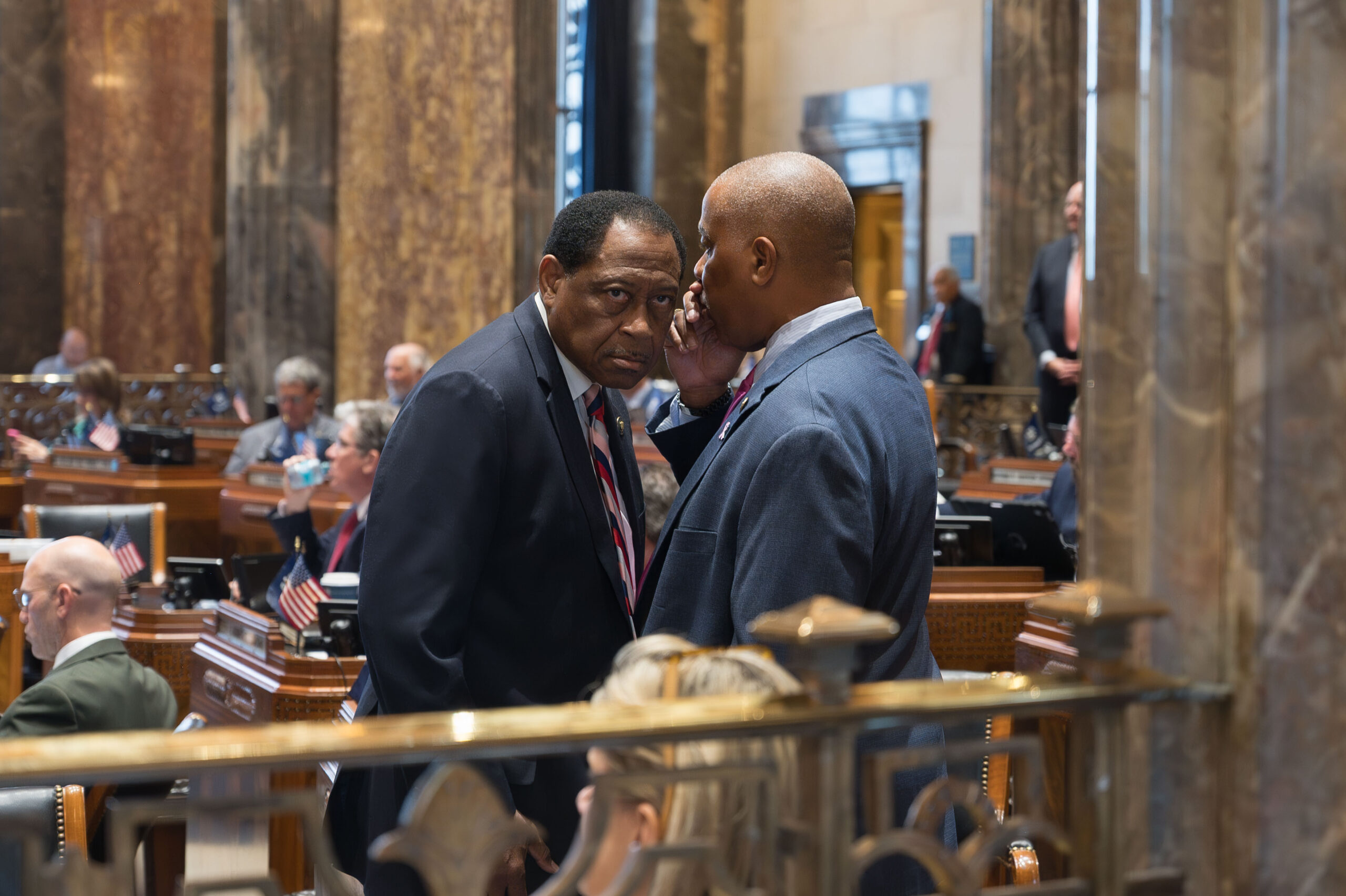
By Avery White | LSU Manship School News Service
BATON ROUGE — Every time legislation is on the floor, there are always voices echoing through the chambers, firing off questions and pushing perspectives not in lockstep with the majority.
These days, the opposing voices in the sea of noise are usually Democrats, who total only 39 of the 137 members of the Louisiana Legislature. Making up just under 30% of the collective, they are almost always outvoted now.
Their numbers have dwindled since Louisiana began to shift in the early 2000s from a majority Democratic state to majority Republican. And so has their ability to be involved in compromises since Democratic Gov. John Bel Edwards gave way to Republican Gov. Jeff Landry in early 2024.
Yet, they keep fighting, whether it’s to stand up for their constituents on issues like education or health care or to lay the groundwork for legal challenges to some new laws.
“You’re fighting for the people that sent you there, and as long as they see you fighting, it’s important that we continue to tell their stories,” said Rep. Venessa LaFleur, D-Baton Rouge. “That we continue to fight for them, knowing what the outcome is. But that doesn’t lessen the fight that is within us.”
When the House was voting last fall to delay the statewide primary election in 2026 for a month while the U.S. Supreme Court considers the legality of the state’s two majority-minority congressional districts, Democrats debated on the floor for two hours, knowing they were going to lose.
Rep. Candace Newell, D-New Orleans, was one of the loudest voices against the bill, boldly stating that the actions were an effort by Republican legislators to rig elections to reduce minority representation. The bill passed 73-29.
“We knew that in this new term we were going into a supermajority,” Newell said, referring to Republicans holding more than two-thirds of the seats in both the state House and Senate. “When we see so many things that pass, so many bad bills that passed so easily, it’s disheartening.”
Republicans in the Legislature hold what is called a trifecta and triplex, meaning the party holds the offices of governor, secretary of state, attorney general and a majority in both chambers.
This means Republicans can pass just about any legislation they agree on with little fight, leaving many of the Democrats to feel as though the process is purely procedural.
“They go through all the pomp and circumstance of saying things that aren’t true, saying things that you know are really not relevant to what they’re really trying to do,” Rep. Rodney Lyons, D-Marrero, said. “But it’s just a part that they have to go through. So, what’s going through my mind is, ‘Here we go again. You know, how long are we going to sit through this piece.’”
For many decades, it was the Republicans who were left without a voice across a solid Democratic South.
Through shifts in national politics and redistricting efforts, Republicans gained the foothold that has led to their dominance, said Jay Dardenne, a Republican who served as lieutenant governor and as a top official in Gov. Edwards’ administration.
“It’s just a shift in in the South, but particularly in Louisiana, to Republican supermajority status, and now a Republican governor,” Dardenne said. “As well as the districts that have been created that kind of have resisted a need to compromise, which is part of the legislative process.”
Democrats were crucial to some compromises during the eight years when Edwards was governor.
In 2018, it took three special sessions before a mix of Democrats and moderate Republicans agreed on a fraction of a cent of additional sales tax to close a steep budget gap. More-conservative Republicans had refused to vote for any increase.
“We had an element of success, did what had to be done with the help of some of them, with most all the Democrats, as well as some Republicans,” Dardenne said.
However, with the shift in politics now, it is harder to come to compromises because of ironclad loyalty among parties, according to Edwards.
“It makes it very hard for a group in the center of the political spectrum to work together, and we used to see that in Congress, and I don’t think we’re better for it,” the former governor said at an event at LSU last week.
“In Congress, now it is a bad thing to be seen talking to members of the opposite party or working with them on anything of any significance,” Edwards added.
Nowadays, only four of the 39 Democrats are white. The Black Democrats are mostly from urban and suburban areas and work together as members of the Louisiana Legislative Black Caucus.
Democrats also just won two additional seats in special elections in February and will win two more in runoffs in New Orleans in March.
When Democrats fight legislation, they also are also laying down records for possible legal battles over the bill.
“I think it’s important to, one, inform the public of the impact of it,” Sen. Samuel Jenkins, D-Shreveport, said. “But also, if there’s going to be any legal challenges to these bills becoming law, then you know a court needs to be able to look to the legislative record or the legislative intent to determine if some kind of violation has taken place.”
In the special session last fall, the Legislature passed resolutions almost unanimously to fund the SNAP food stamps program for November if the government shutdown in Washington had curtailed benefits. While most legislators found this effort to be a good show of the parties working together, Newell noted that everyone came together because some residents of rural Republican districts also depend on food assistance.
“I don’t believe that if so many people in other districts wouldn’t have been heavily impacted…that this is the step we would have taken,” Newell said. “This isn’t the first time we could have stepped up.”
Despite their many losses, Democrats have succeeded at times in blocking legislation.
LaFleur recalled a moment in the regular session in 2025 when the Democrats were able to persuade members of the Senate to block a bill that would have banned diversity, equity and inclusion policies on college campuses even though the programs were already being halted under an order by President Donald Trump.
“Our wins may be small and few in number, but this one mattered most,” LaFleur said.
So, despite the losing record in a sea of red, you’ll still find those voices in the chambers and committee meetings this spring. Like Democrats nationwide, they will be pushing affordability issues in the face of rising food, housing and health costs and opposing limits on voting procedures.
“We’re just living in some very conservative times,” Jenkins said. “But we just need to be careful that we’re not trampling upon our democracy, our fundamental rights of our citizens, voting rights and the quality of life that people want here in Louisiana.”