
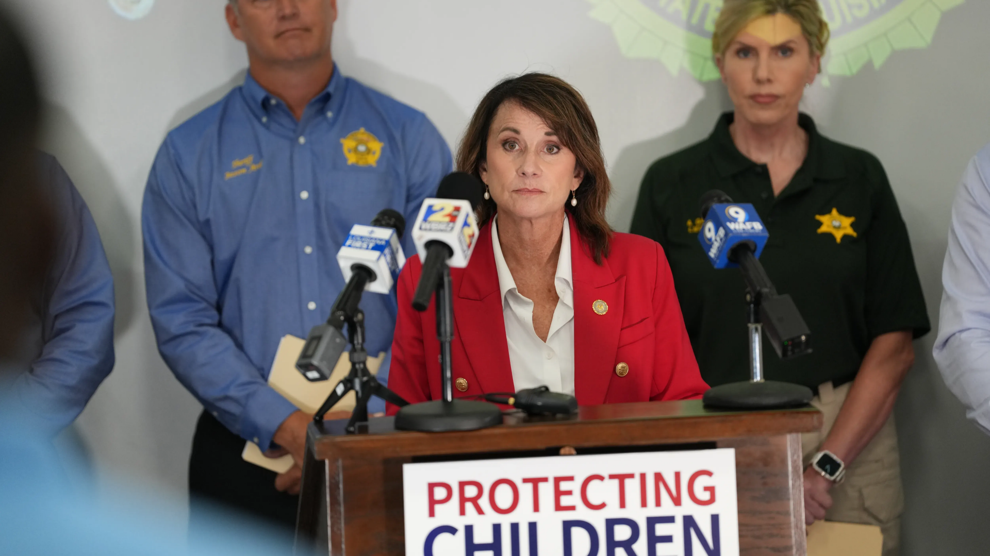
By Greg LaRose | Louisiana Illuminator
A possible truce in the months-long discord between state leaders and New Orleans officials emerged Tuesday when Mayor Helena Moreno, District Attorney Jason Williams and five city council members asked a special prosecutor to drop criminal charges against Louisiana Attorney General Liz Murrill.
“New Orleans and Louisiana have too much at stake to remain consumed by conflict,” Moreno and the council members said in a letter sent to Laurie White, who was appointed to investigate alleged threats Murrill made toward the city officials.
An Orleans Parish grand jury handed up a 16-count indictment July 2 against Murrill on charges of intimidation and malfeasance in office. The investigation centered on a letter Murrill sent to the mayor, DA and council members after they took action to install an interim clerk of court.
In a letter she sent to the city leaders in May, Murrill said Gov. Jeff Landry had the authority to remove the officials from their elected seats after they had circumvented a new state law that combined Orleans Parish’s two court clerks’ offices. Council members appointed an interim clerk, retired Judge Calvin Johnson, and scheduled an election for Nov. 3 for voters to pick a permanent office holder.
Murrill insisted the combined agencies were under the control of the remaining clerk, Chelsea Richard Napoleon, and the Louisiana Supreme Court ruled in her favor. She threatened to jail Johnson if he performed any of the clerk’s duties.
Johnson wrote his own letter to White asking her to dismiss the charges against Murrill.
“We were not intimidated,” Moreno and the council members said in their letter. “While the correspondence at issue contained threatening language directed toward public officials, we never believed those threats could lawfully or practically be carried out.”
In his letter to White, Williams said the “prosecution of Mrs. Murrill is a distraction from the work to which I have dedicated myself.”
The district attorney recused himself and his office from the matter soon after the indictment, and it isn’t publicly known who, if anyone, instructed the grand jury to investigate Murrill.
White did not respond immediately to a voice mail seeking comment Tuesday evening.
Efforts to reach Murrill were directed to her attorney, Laura Cannizzaro Rodrigue, who declined to comment.
Tuesday’s letters are the latest development in an escalating dispute that has pitted Republicans Landry and Murrill against the leaders of the state’s largest Democratic bastion.
A week ago, the governor called the city to heel, saying “New Orleans thinks they’re so special,” as he stressed the need to right-size its court system with separate criminal and civil sections.
“That parish is going to operate exactly like the rest of this state, and the people of this state want that,” Landry said.
The acrimony between the governor and New Orleans leaders took root in the spring as Republican state lawmakers fashioned legislation that focused on what Landry has labeled overdue reforms for the city.
Murrill supported the act that eliminated the Orleans clerk of criminal court’s position, which prevented Calvin Duncan from taking the office in May. City voters overwhelmingly chose Duncan over incumbent Darren Lombard in a November election.
Duncan won in his first run for public office after having spent nearly 30 years in prison for a murder conviction for which he would be exonerated in 2021. He earned a law degree after his release from Louisiana State Penitentiary in 2011, though Murrill has argued Duncan was never cleared of the crime.
In addition to consolidating the clerks’ offices, GOP legislators also approved a law to reduce the number of judges for Orleans Criminal Court. Judge Leon Roché, who appointed White as special prosecutor, was originally one of the judges slated for elimination.
In recusing himself from Murrill’s case, Roché lashed out at Rodrigue after she labeled the grand jury process a “kangaroo court.” The rest of the Orleans Criminal Court bench also sidestepped the case, leading the Louisiana Supreme Court to assign retired appellate Judge Robert Chaisson to Murrill’s case.
Landry and Moreno have also sparred over the city’s financial crisis, which left New Orleans government at one point late last year without barely enough cash on hand to make payroll.
The mayor recently withdrew a $110 million bond financing request from the state Bond Commission, a panel controlled by Landry and his allies from the executive and legislative branches.
The governor also used his line-item veto power last month to cut $33 million in state spending for projects and organization in New Orleans. Landry said the reductions were in line with his pledge to scrutinize allocations to non-governmental organizations.
Earlier this month, Moreno sought to lower the temperature between New Orleans and Baton Rouge by suggesting in a letter that she and Landry meet privately to discuss their differences. The governor responded on social media without accepting or rejecting the mayor’s suggestion, saying the city’s customary practice has been “to utilize the State as an ATM to balance the City’s budget.”