
By Julie O’Donoghue | Louisiana Illuminator
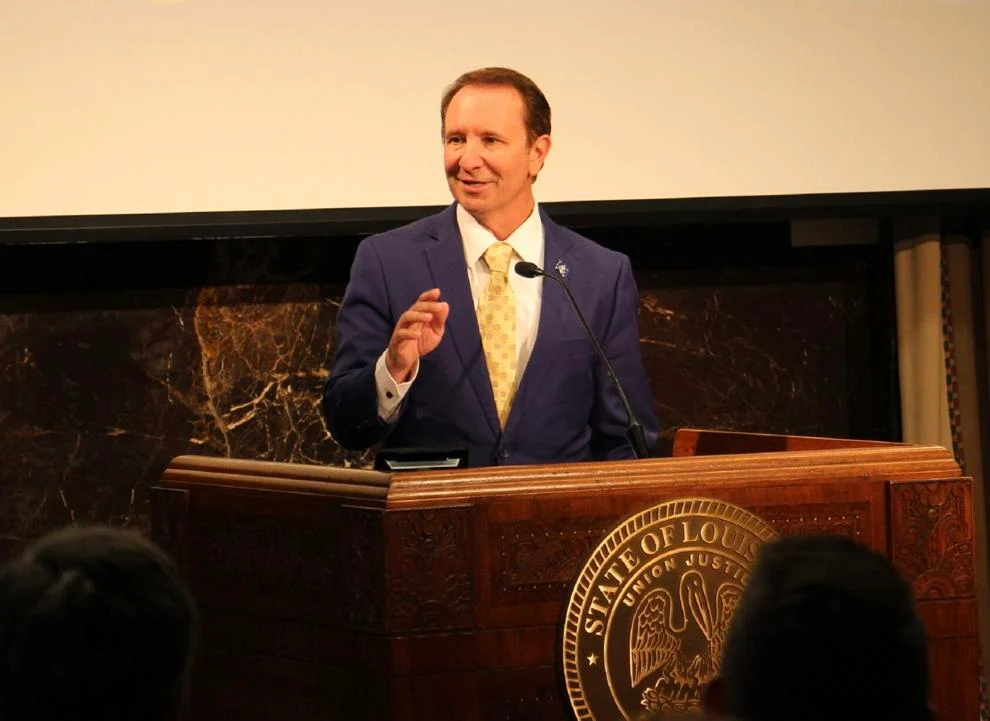
Amid an ongoing power struggle between state Republicans and New Orleans Democrats, Gov. Jeff Landry said New Orleans is no longer as important to Louisiana’s economic success as it has been in the past.
“Used to be, the saying was, ‘Where goes New Orleans, where goes the state.’ Let me tell you what happened today. That has changed, ” Landry said Monday after a press conference announcing the expansion of an enormous Meta data center project in northeast Louisiana.
“Where goes Louisiana will determine the fate of New Orleans, okay?” the GOP governor said.
Landry’s remarks about New Orleans – the largest Democratic stronghold in Republican Louisiana – come after almost two weeks of feuding between the city’s leaders, the governor and Republican Attorney General Liz Murrill, Landry’s closest political ally.
A New Orleans grand jury indicted Murrill shortly before the July 4 holiday over allegations of malfeasance in office and intimidation of New Orleans elected officials.
Since the charges were handed down, the Louisiana Supreme Court has recalled an arrest warrant issued for Murrill. Landry has also made several statements criticizing New Orleans and helped block state approval of a loan the city was planning to take out.
“New Orleans thinks they’re so special,” Landry said Monday. “That parish is going to operate exactly like the rest of this state, and the people of this state want that.”
New Orleans Mayor Helena Moreno responded to Landry’s comments by describing New Orleans as Louisiana’s “largest economic engine” that generates tax dollars for communities across the state.
New Orleans Mayor Helena Moreno holds a news conference to discuss the city’s 2026 legislative agenda.
New Orleans Mayor Helena Moreno (Photo by Robert Stewart/Verite News)
“The focus should always be to strive for every city, every town, and every parish to reach their fullest potential. We are all Louisiana after all,” she said in a written statement Monday.
Moreno, a Democrat, asked to meet one-on-one with Landry, but the governor has shunned the mayor so far. On Monday, he said he would only meet with Moreno once “she understands that they have to get their fiscal house in order.”
Moreno responded in her written statement by saying: “We’re stronger together. My door remains open.”
Prior to Murrill’s indictment, Republican state officials abolished 10 elected New Orleans city positions, including nine judgeships and the criminal clerk of court job, and cut funding to the city’s district attorney’s office this year. Landry also eliminated millions of dollars worth of funding for New Orleans-based construction projects.
Landry, Murrill and Republican legislators said New Orleans was receiving more than its fair share of state funding and support. For example, it has more elected positions than other parishes, they said.
New Orleans officials countered that they were being targeted because the city’s politics, dominated by left-leaning Democrats, is different from the views of the conservative Republicans who run the state.
The charges brought against the attorney general escalated the hostility between city and state leaders in recent days.
The indictment is based on letters Murrill sent to Moreno and other city officials in May. Murrill threatened to remove several New Orleans elected leaders from office over a legal fight related to the abolishment of the city’s criminal clerk of court position.
At the time, Moreno said in a public statement that Murrill’s letters could violate the law.
But the grand jury that indicted the attorney general – made up of New Orleans citizens whose identities are confidential – acted on its own to investigate Murrill, according to the special prosecutor overseeing the case, former New Orleans Judge Laurie White. She was appointed by New Orleans District Court Judge Leon Roche to handle the matter.
When asked by a reporter if he thought the grand jury might have been “put up” to indicting Murrill, Landry declined to answer the question Monday.
“I can’t talk about that … That’s ongoing criminal litigation,” Landry said.
GET THE MORNING HEADLINES.
SUBSCRIBE
While New Orleans is not as big of a player in the state’s financial success as it once was, it still remains important, according to Stephen Barnes, an economist and director of the Kathleen Babineaux Blanco Public Policy Center at the University of Louisiana at Lafayette.
“Over time, other urban areas have grown a bit faster than New Orleans with Katrina having a major and lasting impact in New Orleans,” said Barnes, who also sits on the state’s Revenue Estimating Conference that oversees Louisiana government financial projections, in an email Monday.
“These changes do mean that New Orleans doesn’t loom as large as it used to, but it remains the largest cluster of economic activity of any region in the state,” Barnes wrote.
The Louisiana Department of Revenue tax collection report for the 2024-2025 state fiscal year, the latest data available, shows the New Orleans region was still the powerhouse generator of tax revenue that year.
The New Orleans suburb of Jefferson Parish and Orleans itself were two of the three parishes with the highest gross state sales and income taxes that cycle. The third was East Baton Rouge.
Orleans is also still the third largest parish in terms of population, behind Jefferson and East Baton Rouge.