
By Sheridan White, Avery White and Gracie Thomas | LSU Manship School News Service
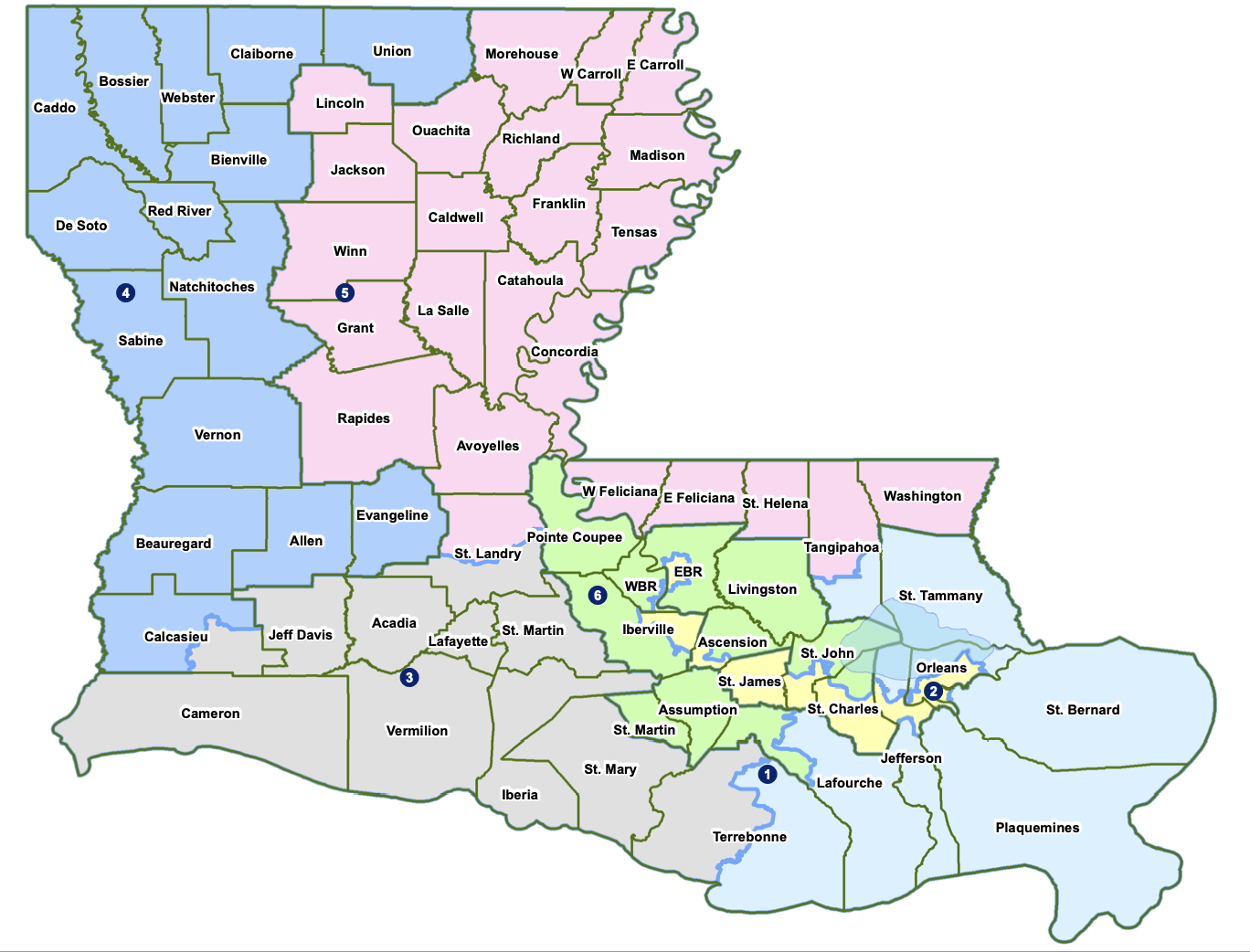
BATON ROUGE– The Louisiana House voted 66-35 Thursday to approve its final version of a new U.S. House map that would give Republicans majorities in five of the state’s six districts.
The amended Senate Bill 121 was passed Thursday afternoon after eight hours of floor debate, the final step before sending the bill back to the Senate to approve the last-minute changes.
Some constituents broke out in protests after the final vote shouting “shame, shame, shame.”
During final debate on the House floor, Democratic lawmakers who oppose seeing the current 4-2 map redrawn to give Republicans a 5-1 edge reignited heated arguments over the role of politics and race in drawing district lines.
“We’re trying to relitigate the Civil War,” said Rep. Wilford Carter, D-Lake Charles, who opposed the redrawn map. “The Civil War is over. We lost the Civil War. … This is just another back step.”
The bill, authored by Sen. Jay Morris, R-West Monroe, and presented in the House by Rep. Beau Beaullieu, R-New Iberia, proposes a new congressional map aimed at reshaping Louisiana’s districts ahead of future elections by eliminating one of the state’s two Democratic districts centered in Baton Rouge and New Orleans.
The map was redrawn following the Supreme Court’s landmark decision in Callais v. Louisiana on April 29 that declared the state’s current congressional map unconstitutional racial gerrymandering. The decision triggered weeks of heated debates and hours-long committee meetings that saw several versions of the current map that will be sent to the Senate for final passage to the governor’s desk before the session ends June 1.
During debate, Beaullieu repeatedly argued that the proposed map was designed to strengthen Republican political influence and protect Republican incumbents rather than account for racial demographics.
“Racial make-up doesn’t matter,” Beaullieu told lawmakers. “What matters is politics.”
While the Callais decision made it clear race could not be used as a main factor in creating congressional maps, drawing maps based on partisanship is within the constitutional lines.
Beaullieu said the map was specifically drawn to protect Republican congressional leaders, including House Speaker Mike Johnson and Majority Leader Rep. Steve Scalise. He also said lawmakers avoided creating a map that would likely produce six Republican-leaning districts because doing so could dilute overall Republican voter strength statewide.
Rep. Aimee Freeman, D-New Orleans, argued that creating maps to protect incumbents is not what they were elected to do.
“Shame on anyone who wants to protect an incumbent when this is the people’s house,” she said.
Democrats offered three amendments throughout Thursday’s debate, all of which ultimately failed along party lines.
Rep. Kyle Green, D-Marrero, proposed an alternative map that would have drawn districts east-to-west rather than north-to-south. Green said his proposal focused on population equality, geography and preserving communities of interest without considering race or party affiliation. His amendment failed in a 31-70 vote.
Rep. Denise Marcelle, D-Baton Rouge, also introduced an amendment that was rejected 30-70.
Another proposal from Rep. Rodney Lyon, D-Marrero, failed 32-69. Lyon argued that previous congressional maps had not disenfranchised voters from either political party and said his proposal attempted to create fairness by partially considering race in the redistricting process.
Beaullieu objected to all three amendments, saying that the proposed amendments would have reduced Republican power and values in the state. He later introduced his own amendment to SB 121, saying it would keep more communities of interest together within district boundaries.
Rep. Mandie Landry, D-New Orleans, questioned Beaullieu on the population used in the making of his amended map, saying the numbers used were about 500,000 voters shy of the number provided by the secretary of state.
“This is pretty important because if there are half a million voters that were missing, your numbers and how many people are in each district are not going to be accurate,” Landry said.
Rep. Carter, a Vietnam, spoke in opposition to SB 121 in an effort to give hope to those who may be losing hope in the fairness of American democracy.
“When I went in the Army, I was willing to die for this country, and I’m still willing to die for this country,” Carter told his fellow lawmakers. “America is less great than it’s ever been. … America is still worth dying for. It’s not this, but it’s going to get better.”
The map to be confirmed by the Senate would eliminate District 6 held by U.S. Rep Cleo Fields, D-Baton Rouge, leaving U.S. Rep. Troy Carter, D-New Orleans to hold the remaining Democratic seat in District 2.
Outside the Capitol, the revised map also drew criticism from Republican U.S. Rep. Clay Higgins, who posted his opposition on social media platform X.
“This Frankenstein looking thing was NO DOUBT drawn up by a very small handful of guys in a secret room,” Higgins wrote. “I am 100% opposed to this latest and worst iteration of proposed Louisiana Congressional Districts.”
The post was read aloud on the House floor during debate, and Rep. Edmond Jordan, D-Baton Rouge, expressed his surprise in agreeing with Higgins.
“Hell must have frozen over,” Jordan said to laughter.
While the Legislature moves to pass a new map before the session ends on Monday, the Callais plaintiffs in the Supreme Court case indicated they may file suit if the Legislature does not eliminate both Democratic districts in the new map.
“The current legislative session ends on June 1, 2026,” they wrote. “If the Legislature fails to enact a new map by then or enacts SB121 without any substantial changes to the current structure, Plaintiffs may well ask the Court to schedule proceedings to impose a remedy that fully complies with Callais.”
Constituents wearing “Black Voters Matter” T-shirts gathered in the Capitol atrium before the House debate protested the passage of the bill, chanting about democracy and voting lawmakers out.