
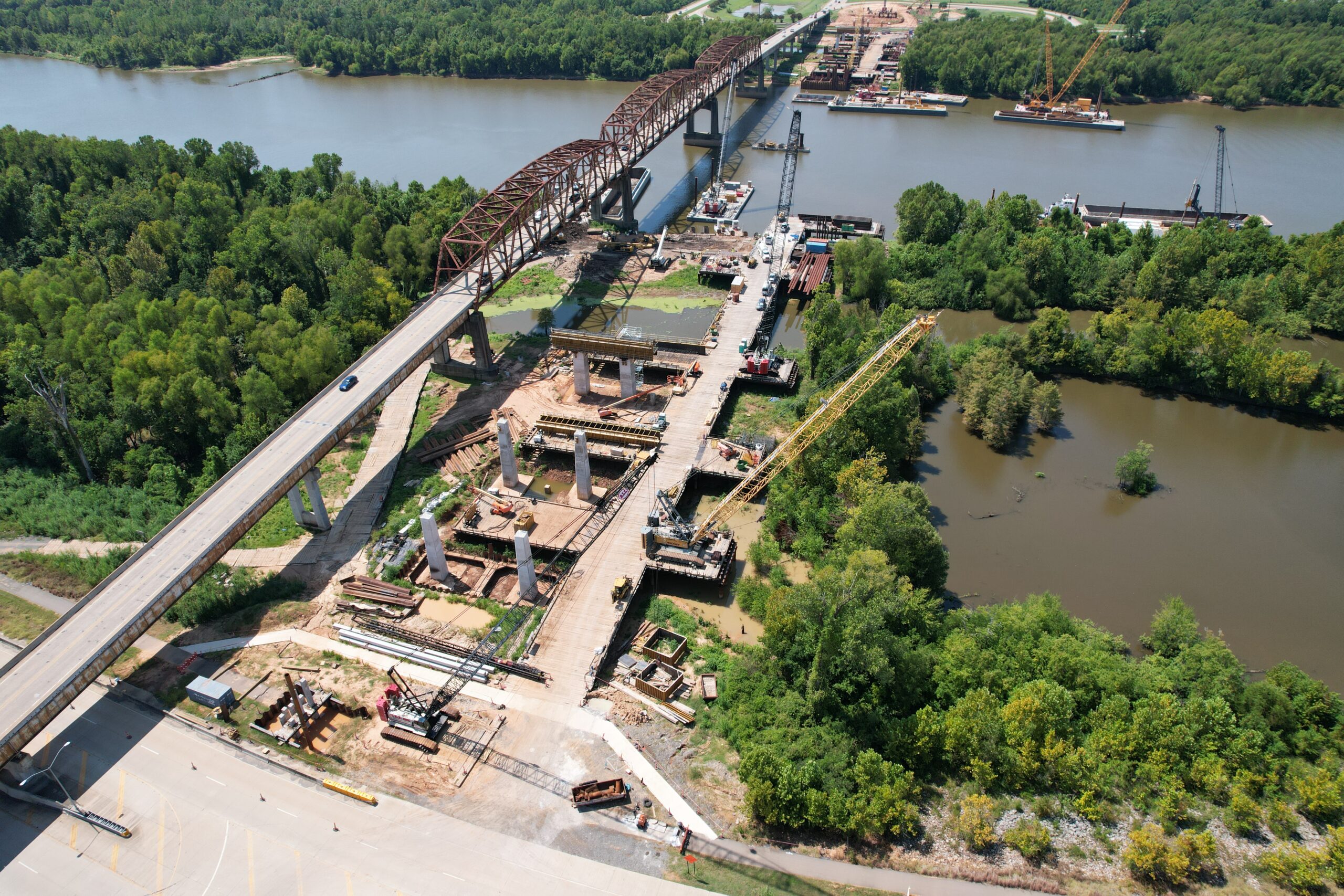
(The Center Square) – For decades, daily commuters and residents had sought a solution for traffic congestion over the Jimmie Davis Bridge between growing neighborhoods and businesses in east Shreveport and south Bossier.
As far back as the 1990s, the Louisiana Legislature raised concerns about safety and the limited capacity of two traffic lanes. But government processes advance slowly. The feasibility study was done 17 years ago, while environmental reviews took six more years. Another nine years passed before construction began in 2024.
The National Environmental Policy Act carries a host of requirements to consider. The Louisiana Department of Transportation and Development had to, among other things, develop a range of alternatives, analyze impacts to the Red River and wildlife and gather public input. The project had to satisfy the NEPA to receive federal funding.
Now, the landmark project is approaching a milestone. In just over a year, the new $362 million four-lane span over the Red River – which carries approximately 30,000 vehicles per day – is set to open. It’s a monumental project, featuring 16,600 feet of concrete piles, 19,820 cubic yards of structural concrete, 4 million pounds of reinforcing steel and 14,000 feet of concrete bridge girders.
Baton Rouge-based James Construction Group is building it next to the existing truss bridge, built in 1968. Construction remains on schedule and is expected to open to vehicular traffic in mid-2027, according to Erin Buchanan, a Department of Transportation and Development public information officer.
“As we move further along in construction, we’ll be able to provide a more specific timeline,” Buchanan said.
One of five bridges that span the metro area’s two cities, it will double current traffic capacity, and it is the state’s second most costly bridge project in recent years. The Interstate 10 Calcasieu River Bridge replacement project near Lake Charles costs $2.1 billion.
The transportation department used a design-build format, a method that accelerates the project’s timeline by overlapping design elements with construction. An early option that was considered but rejected suggested rehabbing the existing two-lane bridge and adding another two lanes “but the public wanted four new lanes,” Buchanan said.
The project spent $2.3 million for “right-of-way cost” but specific locations and purchase amounts for property are confidential, she said.
The project was funded through a combination of $106 million in state bonds, less than $300,000 in state cash, $154 million from the National Highway Performance Program and $100 million from the American Rescue Plan Act.
Depending on the construction schedule, there are anywhere between 50 to 100 people working around the clock, seven days a week: heavy equipment operators, welders, carpenters, concrete finishers, surveyors, crane operators, project engineers, design engineers and inspectors.
The existing structure will be rehabilitated and transformed into a linear park, connecting the trail systems in Bossier and Caddo parishes to provide bicycle and pedestrian crossings over the Red River. Bridge maintenance and management falls to the local Department of Transportation and Development district, while the repurposed bridge will be transferred to Louisiana State Parks.
In the meantime, the transportation department had issued information about upcoming nighttime closures of Clyde Fant Parkway in Shreveport, from March 9-20. The closure is needed for equipment mobilization and girder installation.