
Julie O’Donoghue | Louisiana Illuminator
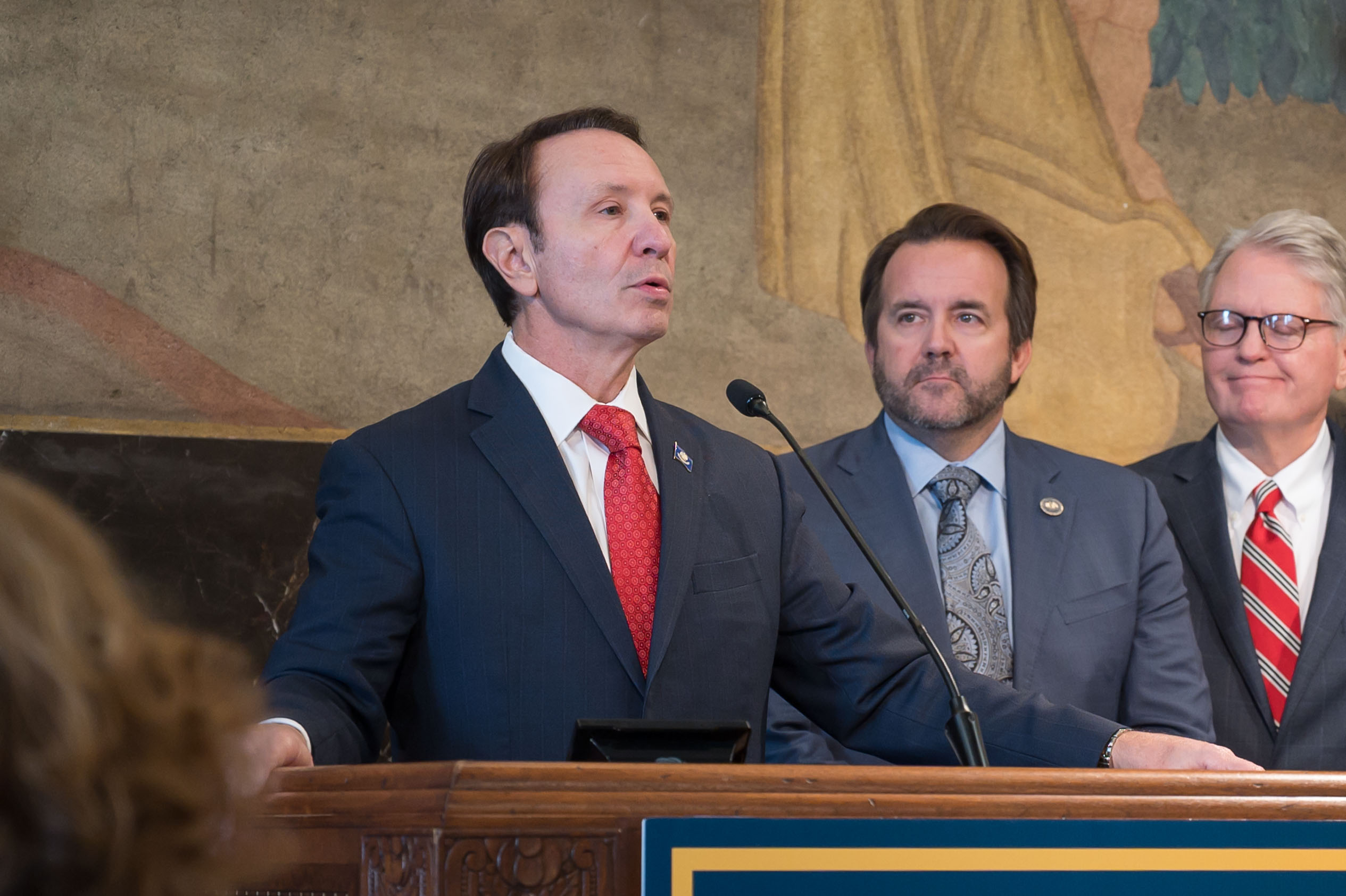
Gov. Jeff Landry said he intends to change the role of the state Office of the Inspector General, an agency that acts as a watchdog over public officials and is tasked with rooting out government corruption.
The governor has replaced longtime Inspector General Stephen Street, who has held the job since 2008, with Angele Davis, who was commissioner of administration and budget czar for former Gov. Bobby Jindal from 2008-10. Street’s most recent term, which started in 2020, expired this week.
The governor’s vision for the reworked state inspector general office goes beyond just a personnel change. He said at a news conference Thursday the inspector general duties overlap too much with the functions of the legislative auditor, whose staff also conducts investigations into government fraud and waste.
“The question is: Is somebody else doing the same work as the inspector general?” Landry said. “And when you look at it, the legislative auditor’s function is very similar to the inspector general’s office.”
While not giving many details about his proposal, the governor described the “new” inspector general’s office as “connected to optimization and efficiency within state government.” The governor said Davis will not only be known as the inspector general but also as the state’s “chief integrity officer” in her new role.
Landry expects Davis to focus on finding ways for the state government to save money, such that Louisiana will be able eliminate its personal income tax in the future, he said.
Currently, the inspector general and his staff focus some of their resources on criminal investigations, which is not Davis’ area of expertise. She has a professional background in public finance and government operations.
“I think that it will be heartwarming to many legislators to be able to finally have a officer in the executive department that’s going to take information from auditor and go try to find efficiencies in state government,” Landry said of his vision for the revamped inspector general position.
Legislative Auditor Mike Waguespack, who was also at Thursday’s news conference, said he envisions the inspector general becoming more of an “internal auditor” for the executive branch.
The governor also suggested the inspector general’s office might lose its designation as a law enforcement agency.
“Look, over the years, we’ve built a lot of police powers in our [inspector general] department. Somebody seems to want to carry a badge and a gun,” Landry said. “It’s a great debate that we’ll have at the legislature whether we need that power.”
Davis said she intends to review whether the inspector general office should retain its law enforcement status.
“If there are duplications in services, the inspector general doesn’t need to be doing the same thing that the attorney general is doing or the same thing that the legislative auditor is doing,” she said.
Landry said some changes he wants to make require the Louisiana Legislature to alter state laws. He plans to back bills to overhaul the inspector general’s office in the upcoming lawmaking session that starts March 9.
The inspector general’s office was set up in state law as part of a wider ethics and anti-corruption legislative package Jindal pushed during his first few months as governor in 2008. Prior to that time, governors designated inspector generals through executive order.
An overhaul of the office would follow other dramatic changes Landry has made to state government entities that serve as watchdogs and check on state officials’ power.
In 2024, Landry pushed through significant changes to the Louisiana Board of Ethics that weakened its independence and brought the agency further under the governor’s control. He also backed the elimination of some ethics and political campaign spending restrictions last year.
While the legislative auditor and inspector general share some overlapping functions, as the governor said, the two positions are structured differently. In general, legislators have more direct authority over the legislative auditor than the governor does over the inspector general.
The inspector general is nominated by the governor and confirmed by the Louisiana Senate to serve a six-year term. The person’s time in office intentionally doesn’t line up with the governor’s or state lawmakers’ four-year terms in order to somewhat insulate the inspector general from political pressure.
The legislative auditor is voted into office by state lawmakers and serves no specific term, though he or she must be a certified public accountant.
Landry also can’t fire the inspector general as easily as his other political appointees. Under current law, he needs the majority of legislators in both chambers to approve the removal of an inspector general before his or her term expires.
Both the inspector general and legislative auditor have subpoena power, meaning they can compel a person to testify or hand over documents, but who approves their subpoenas differs.
The legislative auditor can only subpoena people if the Legislative Audit Advisory Council, made up of the state lawmakers who hire the auditor, agrees to do so. The inspector general gets approval for his subpoenas from a state judge with the 19th Judicial District in Baton Rouge.
Prior to becoming commissioner of administration for Jindal, Davis worked for former Gov. Mike Foster and Mitch Landrieu when he was lieutenant governor. She was also an unsuccessful Republican candidate for state treasurer in the 2017 race won by Republican John Schroder.
Street, an attorney, was on the staff at the state’s Third Circuit Court of Appeal and the Louisiana attorney general’s office before becoming inspector general.
“Serving 18 years as Louisiana’s Inspector General has been one of the great honors of my life, both personally and professionally,” Street said in a written statement Thursday.