
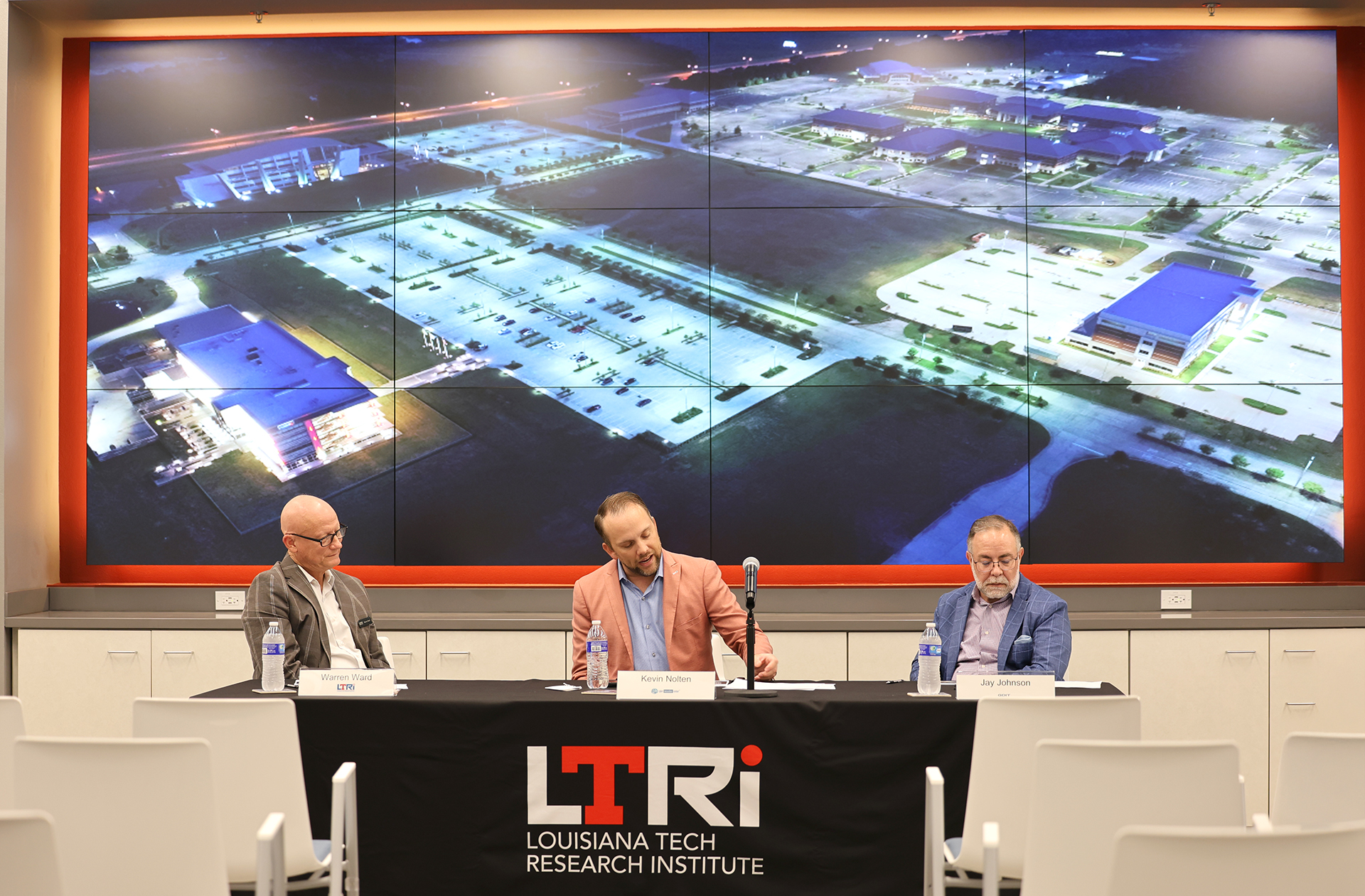
BOSSIER CITY, La. — Cyber Innovation Center President Kevin Nolten outlined the growth and economic impact of the National Cyber Research Park during a recent innovation forum at the Louisiana Tech Research Institute.
Nolten was joined by Jay Johnson, vice president of Technology Shared Services Customer Engagement for General Dynamics Information Technology, and Warren Ward, executive director of LTRI. Nolten said collaboration among CIC, GDIT, LTRI, and Bossier Parish Community College has been central to the park’s progress.
“When we talk about collaboration and innovation taking place, we couldn’t have scripted it any better,” Nolten said. “This is the natural evolution of a community wanting to make a difference.”
The National Cyber Research Park, launched two decades ago, now includes four buildings with room for continued expansion. The effort aims to build a workforce for high wage technology careers.
Johnson said talent development is critical to the park’s mission. “I don’t build product. I build people. I hope that GDIT is seen as a net talent exporter to the community,” he said.
Nolten emphasized the importance of growing the workforce pipeline. CIC’s CYBER.ORG initiative provides cybersecurity and AI education to K-12 teachers nationwide, helping guide students toward technical careers.
“CYBER.ORG is growing that pipeline of students for colleges like BPCC, who then feed into organizations like GDIT so Jay can hire them after graduation,” he said. “The National Security Administration is looking to CYBER.ORG for curriculum in their academic outreach. That’s a huge testament to what we’re doing.”
CIC’s partnership with Air Force Global Strike Command through its STRIKEWERX division is also accelerating innovation. STRIKEWERX connects AFGSC needs with small businesses and nonprofits to develop lower cost technology solutions.
“We take those AFGSC pain points and pass them to small business and other non-profits who have a really good idea,” Nolten said. “STRIKEWERX can use their process, data team, software, and 3D printing to find solutions that cost a fraction of traditional defense contractors.”
Nolten highlighted three STRIKEWERX projects that contributed to more than 300 million dollars in savings. An augmented reality trainer for air refueling reduced required training flights from 13 to six, saving 10 million dollars per year. A wearable software defined radio is expected to generate one time savings of 200 million dollars. Another AR trainer for security forces eliminated 188,000 dollars in lost equipment costs and 1,000 lost manhours annually.
LTRI also supports AFGSC with research capacity and education programs, including the Global Strike National Security Fellowship Program.
“In five years, we’ve had 45 students from three universities work to solve real world problems for Air Force Global Strike Command,” Ward said.
Nolten said collaboration throughout the park and surrounding business community strengthens workforce and economic development. “We all want to build something that is complimentary to the park and its mission,” he said. “We are working to recruit small businesses to create high paying jobs and keep improving the quality of life.”
Johnson added, “GDIT is working to get small businesses built up — I want to see my people leave me and start a business here. I want to expand that ecosystem to the communities in this region.”